Lucia Lee
Last update: 15/10/2025
A seamless product search can make or break the shopping experience. When customers can’t find what they’re looking for within seconds, they lose patience fast - and you lose potential sales. That’s where smart search for ecommerce comes in. Designed to go beyond simple keyword matching and irrelevant results, this technology-driven solution instantly connects shoppers with exactly what they want. Keep reading to discover how smart search transforms the way customers browse, explore, and buy - and how you can get started.
Smart search for ecommerce is an advanced technology that aims to optimize the product search experience - helping customers find what they need as fast as possible. Powered by artificial intelligence (AI) technologies like machine learning, natural language processing, and computer vision, it enables online stores to truly understand what customers mean, not just what they type. It interprets intent, context, and behavior to deliver results that are highly relevant and accurate to each shopper, giving them a seamless search experience.
Behind every fast and accurate search result is a complex system where advanced technologies work seamlessly together. Here are the key technologies powering smart search for ecommerce.
Smart search for ecommerce is more than just a search bar - it’s an intelligent system that understands, learns, and adapts to every customer’s intent. Below are key features that make smart search a game-changer for both ecommerce businesses and customers alike.
Autocomplete and real-time recommendations
Modern smart search for ecommerce systems use autocomplete to predict user intent as soon as a query begins. This feature speeds up the shopping process by suggesting relevant keywords or products instantly. The system also provides real-time search recommendations dynamically by displaying trending products and popular queries, helping shoppers discover items they might not have searched for directly. Together, they make browsing smoother and keep users engaged throughout their shopping journey.
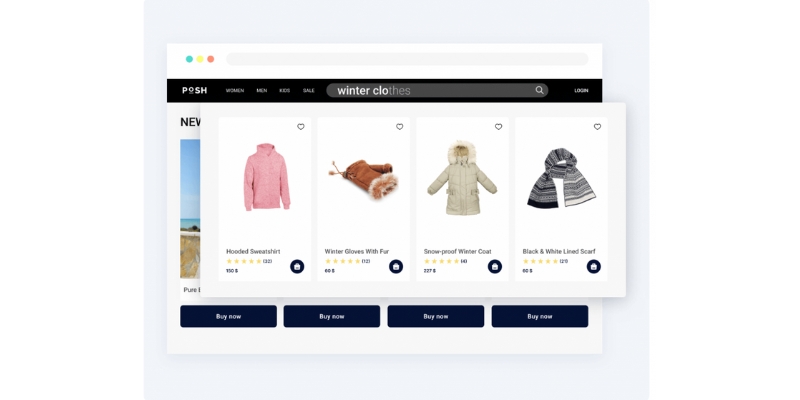
Autocomplete
Voice search functionality
Voice search has become increasingly popular in smart search systems, offering a hands-free way to search for products. Through advanced speech recognition, users can speak naturally instead of typing their queries and get search results instantly. This makes shopping more accessible for people with disabilities, busy users, or those on mobile devices. The system can even interpret accents and mispronunciations, ensuring accurate, convenient, and seamless product discovery.
Semantic understanding of user queries
Semantic analysis is what sets smart search for ecommerce from traditional engines that just match keywords. AI-powered engines understand the intent, context, and relationships between words, allowing customers to find what they mean, not just what they type. Whether a shopper searches for “comfortable office chair for back pain” or “ergonomic chair,” the algorithm delivers contextually relevant results, creating a more intuitive and human-like shopping experience.
Also read: Retail Product Recommendation Engine: Empowering Smart Shopping
Visual product discovery
Visual search lets shoppers find exactly what they want in seconds, skipping the hassle of typing or describing it. By leveraging computer vision and image recognition, it identifies visual elements of items such as color, shape, and pattern. Shoppers can upload or snap a photo to instantly discover exact or similar products, which is ideal for categories like fashion, decor, and lifestyle.

Visual product discovery
Machine learning for continuous improvement
With machine learning in product search, smart search for ecommerce systems constantly evolve by learning from customer behavior. Every click, purchase, and interaction helps refine future search results. Over time, the algorithm becomes smarter at predicting intent, ranking results by relevance, and surfacing items that align with individual preferences.
Personalized search experience
Personalization is the key to better engagement and higher conversions, and smart search delivers just that. By analyzing factors like browsing history, purchase behavior, and demographic data, the system prioritizes items most relevant to each user, ensuring that they see results tailored to their unique preferences and habits. This not only enhances satisfaction but also increases the likelihood of repeat purchases and brand loyalty.
Search relevance and filtering optimization
Behind the scenes, search relevance optimization ensures that users always get the most accurate and valuable results. Using filtering options, relevance ranking, and user intent detection, the system fine-tunes how products appear in search results. This allows customers to refine results effortlessly by category, price, or availability - saving time and creating a more satisfying shopping journey.
Smart search for ecommerce isn’t just about helping customers find products faster - it’s about transforming how they experience your store. When done right, it turns casual browsing into confident buying, creating a win-win for both shoppers and retailers. Below are the key benefits that you and your customers can reap:
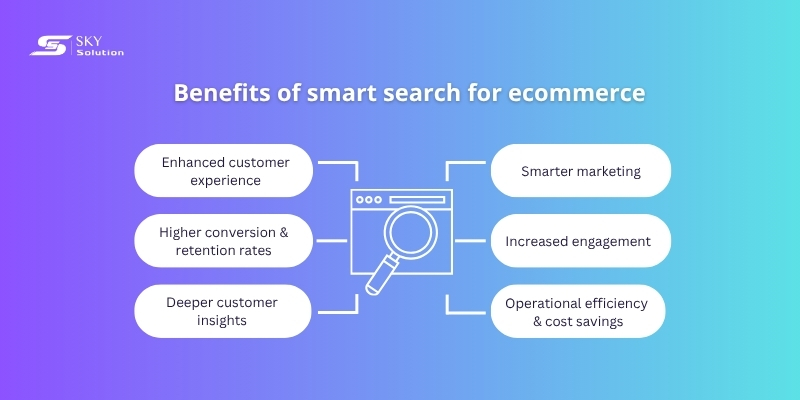
Benefits of smart search for ecommerce
Enhanced customer experience
In today’s fast-paced digital world, you only have a few seconds to capture a shopper’s attention before they leave your store empty-handed. Smart search for ecommerce ensures that those seconds count by helping customers instantly find what they’re looking for without frustration or endless scrolling. This seamless experience mirrors the helpfulness of an in-store assistant, keeping shoppers satisfied and engaged.
Also read: The Future of AI in Ecommerce: Top Trends To Watch
Higher conversion and retention rates
With smart search features like real-time intent prediction, users are guided smoothly toward their desired products, often before they even finish typing. When customers find relevant products effortlessly, they’re far more likely to make a purchase. Over time, this builds trust and loyalty - two key ingredients for higher conversion rates and repeat sales.
Deeper insights into consumer behavior
Every search query tells a story. AI-powered search for e-commerce captures these valuable signals, providing ecommerce businesses with deep insights into what customers want, how they shop, and what drives their buying decisions. By analyzing these trends, you can refine your product offerings, optimize pricing, and tailor marketing strategies to meet customer expectations more effectively.
Smarter marketing
With visibility into customer intent and search patterns, your brand can strategically promote trending or high-converting products to maximize the efficiency of your marketing efforts. Smart search for ecommerce systems powered by machine learning helps identify which items resonate most with users and surfaces them prominently across search results or recommendation panels. This data-driven approach makes marketing more targeted, efficient, and profitable.
Increased engagement and lower bounce rates
A poor search experience can quickly drive customers away - but smart search keeps them browsing longer. Real-time search recommendation systems provide personalized suggestions that can reduce bounce rates and boost session duration. The more time shoppers spend discovering relevant products, the greater the chance they’ll add more to their cart.
Operational efficiency and cost savings
An optimized search experience doesn’t just benefit customers; it also helps your team. When users can easily find what they need, fewer inquiries reach customer support. That means your staff can focus on higher-value tasks instead of manually guiding users through product discovery. Ultimately, this reduces customer acquisition costs while improving overall operational efficiency.
Smart search isn’t just a futuristic concept; it’s already transforming how some of the world’s biggest online retailers operate. From personalization to semantic understanding and visual recognition, here’s how top e-commerce leaders are using it to deliver faster, smarter, and more engaging shopping experiences.
Amazon: Setting the standard for intelligent product discovery
Amazon’s search engine is one of the most advanced in the ecommerce world. It goes far beyond simple keyword matching by using AI-powered algorithms to understand user intent. Even vague or incomplete queries return highly relevant results, thanks to Amazon’s ability to analyze browsing and purchase history. Moreover, features like “Customers who bought this also bought” and personalized product recommendations create a seamless shopping journey that keeps customers coming back and spending more.

Amazon's smart search
Walmart: Smarter, faster, more context-aware search
Walmart takes semantic search for online stores to the next level with its innovative “semantic caching” system. Unlike traditional caching, which depends on exact matches, semantic caching interprets the meaning behind each query. This allows Walmart’s search engine to handle variations in language and phrasing effortlessly, ensuring users always get relevant results - even from long-tail or unusual searches. Combined with real-time spelling correction, localized results, and personalized recommendations, Walmart’s smart search engine significantly enhances both speed and accuracy.
Shopee: Visual search for effortless product discovery
Shopee integrates visual search in e-commerce to simplify how users find products. By simply tapping the camera icon, shoppers can upload a photo or take one in real time to search for visually similar items. This computer vision-powered feature is especially helpful for shoppers who don’t know a product’s exact name, making product discovery faster, more intuitive, and accessible to everyone.
Now that you’ve learned about the immense benefits of smart search for ecommerce, you may be wondering how to start adopting it. Follow the practical guide below to get started:
Step 1: Choose the right smart search technology
The foundation of implementing smart search for ecommerce lies in selecting the right technology that fits your ecommerce ecosystem. While many ecommerce platforms like Shopify and BigCommerce provide basic built-in search options, advanced third-party tools such as Algolia, Elasticsearch, or Coveo deliver far greater intelligence and flexibility.
The ideal smart search solution should incorporate AI and machine learning to interpret intent and context, support real-time indexing to ensure fast product updates, integrate smoothly with your existing system, and scale effectively as your product catalog expands.
Step 2: Optimize your product data
Even the most advanced search technology will underperform without clean, well-structured product data. Every product title, description, tag, and metadata field should be written with precision and clarity.
Detailed yet easy-to-read product descriptions help the search engine understand relevance, while including synonyms and alternate spellings ensures that user queries - no matter how phrased - return accurate results.
Visual elements should also be optimized with descriptive tags to enhance visual and context-aware product search capabilities. This step forms the backbone of effective product discovery.
Step 3: Implement search analytics
Search analytics play a crucial role in understanding customer intent and behavior. By monitoring how users interact with your search function, you can identify what products are most frequently searched for, which terms result in zero matches, and how customers navigate your catalog.
Implementing analytics tools such as Google Analytics or specialized search analytics dashboards allows you to transform raw search data into actionable insights. These insights can then guide content optimization, refine autocomplete functions, and support personalized suggestions that align with real-time search trends.
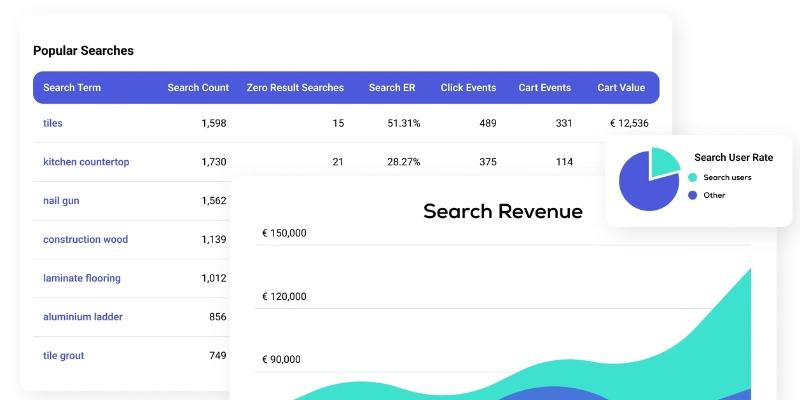
Implement search analytics
Step 4: Test and optimize for performance
Before fully deploying smart search for ecommerce, it’s essential to test its performance from multiple angles. Testing ensures that results are not only fast and accurate but also relevant to user intent.
Conducting A/B tests on different ranking algorithms, gathering feedback from real shoppers, and monitoring page load times all contribute to a smoother and more satisfying experience. Continuous testing helps uncover small issues that could affect usability and gives you the opportunity to fine-tune your system before full-scale implementation.
Step 5: Continuously improve with AI and machine learning
Smart search for ecommerce is not a one-time setup - it’s a dynamic system that evolves with your customers. By leveraging AI and machine learning, your search function can learn from user interactions, gradually refining relevance and personalization. Over time, the system becomes more intuitive, offering tailored product recommendations, improved autocomplete accuracy, and better product discovery.
Consistently monitoring performance, updating algorithms, and experimenting with emerging features such as voice or conversational search will help your brand stay ahead of competitors and deliver a truly intelligent shopping experience.
In today’s fast-paced digital marketplace, a smart search for ecommerce system isn’t just a nice-to-have - it’s the engine that drives product discovery, customer satisfaction, and revenue growth.
If you’re ready to elevate your online store with a smart, seamless shopping experience, partner with Sky Solution. Our tailored ecommerce solutions are designed to help your business attract, engage, and convert customers with ease. Contact us now for a free consultation!




.jpg&w=3840&q=75)