Lucia Lee
Last update: 16/10/2025
AI agents are taking the business world by storm - and for good reason. They’re redefining how businesses automate processes, serve customers, and make decisions at scale. More and more businesses are turning their attention to AI agent development to stay ahead of the curve. But how exactly do you go from concept to a fully functioning AI agent that delivers real business impact? In this guide, we’ll break down the key steps, tools, and best practices to help you understand how AI agent development works - and how your business can harness its full potential.
An artificial intelligence (AI) agent is an advanced software program designed to act, think, and learn on its own to achieve specific goals. Unlike traditional systems that rely on manual input, AI agents are autonomous systems that can analyze data, make decisions, and execute actions without human intervention.
Also read: Types of Agentic AI Agents Explained with Examples
AI agents are not just tools; they’re fundamentally rethinking how decisions are made, how customers are served, and how growth is sustained. Here’s why investing in AI agent development can transform your business and give you a competitive edge over businesses that don’t:
Boost efficiency and reduce costs
AI agents automate repetitive, time-consuming manual tasks with high accuracy, freeing your teams to focus on high-value work. This helps your businesses achieve both significant cost savings and faster turnaround times without increasing headcount.
Enhance decision-making with real-time insights
With machine learning and predictive analytics at their core, AI agents can process massive amounts of data in real time. This enables smarter, faster business decisions, whether it’s predicting demand, optimizing ad spend, or identifying risks before they escalate.

Enhance decision-making with real-time insights
Deliver personalized customer experiences
In a market where personalization drives loyalty, AI agents powered by natural language processing can analyze customer data, preferences, and behaviors to tailor experiences across channels. They can power chatbots, recommend products, or provide instant support - all while learning from each interaction to serve customers even better next time. This not only boosts satisfaction but also strengthens long-term retention.
Also read: Personalization in Ecommerce: Benefits, Examples, and More
Scale without growing costs
Unlike human teams, AI agents can easily scale with your business. Whether you double your customer base or expand to new markets, they can handle higher workloads with consistent accuracy and performance, making them a cost-efficient way to grow operations sustainably.
Achieve continuous operations and global reach
AI agents don’t sleep. They operate 24/7 across time zones, ensuring your business stays active and responsive around the clock. This constant availability helps meet global customer expectations, providing a seamless experience no matter where or when interactions happen.
Future-proof your business
Competitors are already leveraging AI to accelerate service delivery, automate outreach, and gain market intelligence. Without intelligent automation, businesses risk falling behind. AI agent development helps you stay ahead - not only by keeping pace with change but by shaping it.
Before diving into our step-by-step AI agent development guide, it’s critical to understand what goes into creating intelligent, goal-driven systems. Let's have a glimpse into the building blocks of developing AI agents.
At its core, an AI agent is made up of several components that form the foundation of intelligent, autonomous behavior. Let’s break them down:
Perception and input handling
Every AI agent begins with perception - the ability to gather and interpret data from its environment. This component acts as the agent’s sensory system, collecting information such as user prompts, sensor data, or system logs, and converting it into a structured form that can be understood. The precision of perception determines the overall reliability of an agent’s performance.
Reasoning and decision-making
Once the input is understood, the agent must determine the best course of action. This is where decision-making algorithms and neural networks play a key role. These systems evaluate available options, weigh probabilities, and choose actions that best achieve the agent’s goal.
Memory systems
Memory provides the foundation for continuity, context, and learning. It allows AI agents to store, recall, and build upon previous knowledge. Short-term memory preserves context within an ongoing task or conversation, ensuring coherence and relevance, while long-term memory maintains historical data, user preferences, and learned experiences.
Tool calling and integration
Tool calling empowers AI agents to extend their capabilities beyond internal reasoning. By invoking external tools, APIs, or systems, agents can retrieve real-time information, execute commands, and perform complex operations autonomously. This integration bridges the gap between intelligence and action.
Learning and adaptation
The learning component enables continuous improvement through data-driven experience. Using reinforcement learning and other machine learning methods, AI agents refine their performance by analyzing feedback and outcomes. This ability to evolve ensures that the AI remains resilient and effective in dynamic, ever-changing environments.
Action and communication
The final stage transforms reasoning into real-world impact. The action module executes planned tasks while the communication module handles interactions with users, other agents, or digital platforms.
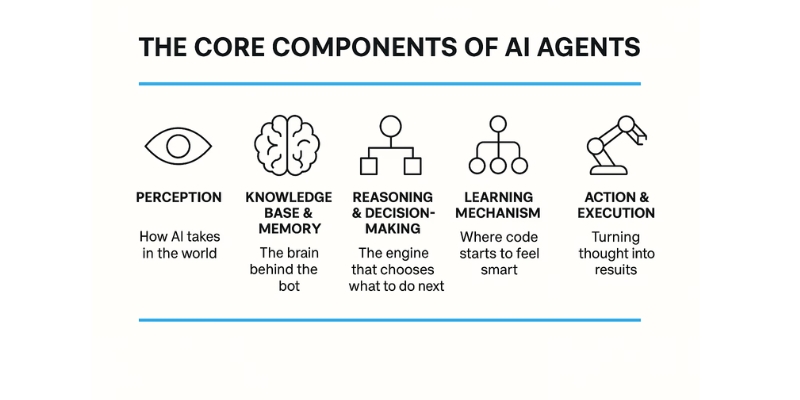
Key components of an AI agent
AI agent architecture is the structural foundation that defines how intelligent systems perceive their surroundings, process data, and act to achieve specific goals. There are two major types of architectures: single-agent and multi-agent.
This approach is simpler to design and manage, making it ideal for straightforward use cases. However, it can struggle with scalability and adaptability when tasks become highly complex.
These systems excel in handling large-scale, multi-domain, or fast-changing environments such as supply chain optimization, autonomous vehicles, and intelligent automation systems, where tasks are too complex for a single agent to manage effectively.
Frameworks for AI agent development form the foundation for building, deploying, and managing intelligent autonomous systems. These frameworks remove much of the complexity from development, offering ready-made components and integrations that allow businesses to create sophisticated AI solutions faster and with greater reliability. They are often made up of:
Building an AI agent from scratch may sound complex, but with the right approach, it’s entirely achievable. In this step-by-step guide on building AI agents, we’ll walk you through everything you need to know about AI agent development.
Every effective AI agent begins with a well-defined purpose. Before jumping into development, take time to clearly identify what problem your agent will solve, who it will serve, and how it will deliver value. Without this clarity, your project risks becoming unfocused and inefficient.
Ask yourself:
By defining these details early, you establish a clear direction for your AI agent. It ensures that every design, data, and integration choice serves a specific goal, setting the foundation for measurable success.
Once the goal is defined, the next step is selecting the technological foundation. This includes programming languages, AI frameworks, and agent-building platforms.
Programming languages commonly used:
Before picking a platform for AI agent development, evaluate it against these essential criteria:
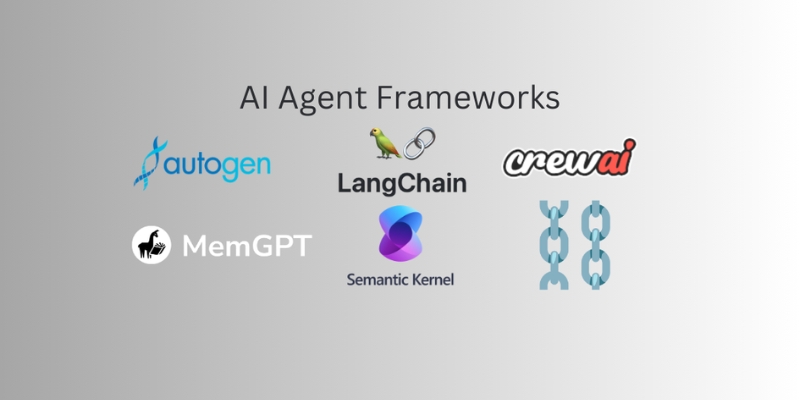
AI frameworks
Once you’ve considered the factors above, explore some of today’s leading frameworks for AI agent development:
Your AI agent can only perform as well as the data behind them. Follow these best practices to build a strong, reliable data foundation for your AI agent’s training and reasoning.
Once you’ve defined the purpose and gathered the right data, it’s time to design how your AI agent will function. This step turns your concept into a clear blueprint for AI agent development.
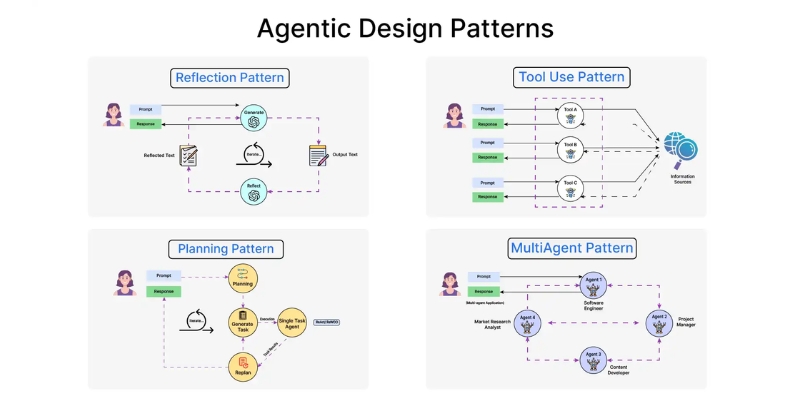
Design your AI agent
Also read: AI Agent Orchestration: Everything You Need to Know
This is where your AI agent development design becomes reality. At this stage, you bring together your chosen models, integrate tools, and train your agent to operate effectively in real-world environments.
Throughout this process, monitor key metrics (e.g., accuracy, precision, recall, loss rate) to ensure your model learns effectively without overfitting.
Even the most advanced AI agent isn’t perfect from day one. Testing and debugging AI agents is a crucial phase of AI agent development that ensures your system performs accurately, consistently, and safely before full deployment.
After thorough testing, it’s time to bring your AI agent to life. Deploying and monitoring AI agents ensures they not only reach users effectively but also continue to perform optimally over time.

Deploy and monitor
AI agent development goes far beyond training a chatbot, and businesses may face several challenges along the way.
Data quality and availability
Agentic AI is only as good as the data that trains it. Poor-quality, biased, or incomplete datasets often lead to agents that produce unreliable or inaccurate responses. Many failures in AI projects stem from using messy or unstructured data - such as incomplete logs or inconsistent text - which limits the agent’s ability to generalize to real-world conditions.
Algorithmic bias
Bias can quietly embed itself into AI systems through skewed training data or limited model design. When this happens, agents replicate societal inequalities such as favoring one gender, accent, or demographic group over another.
Also read: Top Agentic AI Risks Businesses Need To Navigate
Understanding context and user intent
Human communication is inherently ambiguous - full of slang, sarcasm, and indirect cues that AI agents still struggle to grasp. Many agents fail in multi-turn dialogues, losing track of context or misunderstanding what users mean.

Understanding context and user intent
Integration with existing systems
Even a well-trained agent is ineffective if it can’t integrate with existing tools and databases. Many organizations still rely on legacy systems that lack modern APIs or standardized data formats, making seamless integration a major obstacle in agentic AI development.
Scalability and performance
Agentic AI systems must handle high volumes of user interactions and real-time data processing. During peak usage - like sales events or traffic surges - many agents face latency, slow responses, or even crashes.
Engineering complexity and technical limitations
Unlike simple chatbots, agentic AI must manage memory, context, and goals across multiple steps. This introduces engineering difficulties in agentic AI development such as state management, attention scaling, and long-term context retention. Even with large context windows and retrieval-augmented models, issues like hallucination, memory drift, and debugging complexity persist.
Cost and resource constraints
AI agent development is resource-intensive. Costs pile up from GPU usage, large-scale training, data labeling, and continuous inference in production. For startups and small businesses, these expenses can easily exceed initial budgets.
Continuous learning and model drift
AI agents can’t simply be “set and forget.” Over time, models degrade as user behavior, language, and environments evolve. To stay effective, agents require ongoing retraining, performance monitoring, and fine-tuning with new data. Establishing a continuous learning pipeline ensures that the system adapts without breaking existing functionality.
Ethical and legal compliance
Agentic AI often processes sensitive personal or business data, making compliance with data protection laws non-negotiable. Regulations like GDPR and HIPAA impose strict requirements on consent, data storage, and transparency.
Building an AI agent from scratch isn’t just about coding - it’s about designing intelligence that can reason, adapt, and deliver real impact. From defining its purpose and selecting the right framework to testing, debugging, and refining performance, each step of agentic AI development demands precision, patience, and a clear vision.
At Sky Solution, we specialize in AI Agent Development services that go beyond automation - creating intelligent systems built to learn, adapt, and scale with your business. Partner with Sky Solution today and turn your AI ambitions into real-world results.




.jpg&w=3840&q=75)
.jpg&w=3840&q=75)


