Lucia Lee
Last update: 13/11/2025
In today’s fast-moving ecommerce world, success isn’t just about having great products or eye-catching ads - it’s about how well you turn data into decisions. Every click, scroll, and purchase generates insights that can shape smarter strategies, but with millions of data points pouring in every second, traditional analytics simply can’t keep up.
That’s where AI-driven analytics in ecommerce shines. By cutting through data overload and uncovering patterns humans might miss, AI empowers ecommerce teams to make faster, more confident decisions. In this guide, we’ll break down what AI-driven analytics really mean for ecommerce businesses and why they’re quickly becoming the engine of sustainable growth in an increasingly competitive landscape.
AI-driven analytics in ecommerce refers to the use of artificial intelligence technologies - such as machine learning (ML) and natural language processing (NLP) - to transform massive volumes of data into meaningful, actionable insights. Unlike traditional analytics that depend on manual data handling and historical summaries, AI-driven systems automatically detect patterns, learn from behavior, and make real-time recommendations that drive smarter business decisions.
AI-driven analytics doesn’t just tell ecommerce businesses what happened - it helps them understand why it happened and what to do next. This allows teams to automatically optimize marketing campaigns, fine-tune audience targeting, and reallocate budgets in real time, creating a data-driven foundation for faster growth and long-term competitiveness.
AI-driven analytics in ecommerce is transforming how online retailers understand their customers, optimize operations, and drive sales. Let’s explore the key areas where AI-driven analytics in ecommerce is having a profound impact.
Customer segmentation
AI-powered analytics enables ecommerce brands to move beyond traditional demographic-based targeting. Through customer behavior analysis, AI systems can identify patterns in browsing habits, purchase frequency, and engagement history to form precise customer segments. This helps businesses offer the right product to the right shopper at the right time.
Over time, those insights also improve customer behavior prediction using AI, helping brands anticipate how different customer groups will respond to upcoming promotions or new product launches. This is where AI-driven analytics in ecommerce truly shines - turning raw data into customer intelligence that fuels long-term growth.

Customer segmentation
Proactive churn prevention
Every ecommerce business faces the challenge of losing customers - but AI-powered churn prediction makes it possible to prevent that loss before it happens.
AI models can spot early warning signs such as declining engagement, reduced purchase frequency, or abandoned carts. Based on these signals, brands can automatically trigger personalized retention tactics like loyalty rewards or targeted offers.
By identifying at-risk customers early, predictive analytics for ecommerce ensures businesses maintain stronger relationships and build long-term loyalty without relying on guesswork.
Omnichannel customer service
AI-driven analytics in ecommerce also improves customer support across multiple touchpoints - email, social media, live chat, and beyond. By consolidating customer data into a single view, ecommerce teams can deliver seamless, personalized customer service regardless of channel.
Through continuous behavior analysis, AI identifies common service issues and recommends the best responses or upsell opportunities, ensuring every customer feels seen and supported throughout their journey and whichever channel they are in. By having a 360-degree view of customers, service teams can move from reactive problem-solving to proactive engagement, improving satisfaction and lifetime value.
Personalized recommendations
Another notable use case of AI-driven analytics in ecommerce is personalized product recommendations. Recommendation systems and personalization engines analyze user data - past purchases, browsing behavior, time spent on product pages - to suggest items that perfectly match each shopper’s preferences.
Such AI-powered personalization not only improves the shopping experience but also increases conversion rates and boosts average order value. When done right, it turns every interaction into an opportunity to deepen customer connection and loyalty.

Personalized recommendations
Dynamic pricing and revenue optimization
AI-driven analytics in ecommerce help businesses achieve price optimization through dynamic pricing strategies. AI analytics continuously adjusts prices to maximize profit margins - based on factors like real-time market conditions, demand shifts, and competitor activity.
For instance, when certain products see a spike in popularity, AI can recommend ideal pricing points that maximize both profit and customer satisfaction. When demand dips, it can offer subtle discounts to stimulate sales. This data-driven pricing approach ensures competitiveness while protecting margins - a critical advantage in fast-moving ecommerce markets.
Smarter inventory management
Inventory management becomes far more accurate with AI for demand forecasting. By combining sales data, seasonal trends, and external factors such as marketing campaigns or social media buzz, AI predicts which products will be in high demand.
This helps businesses maintain optimal stock levels - avoiding both shortages and overstocking. When connected with warehouse and supplier systems, these predictions can even automate reordering, saving both time and operational costs.
Sales forecasting
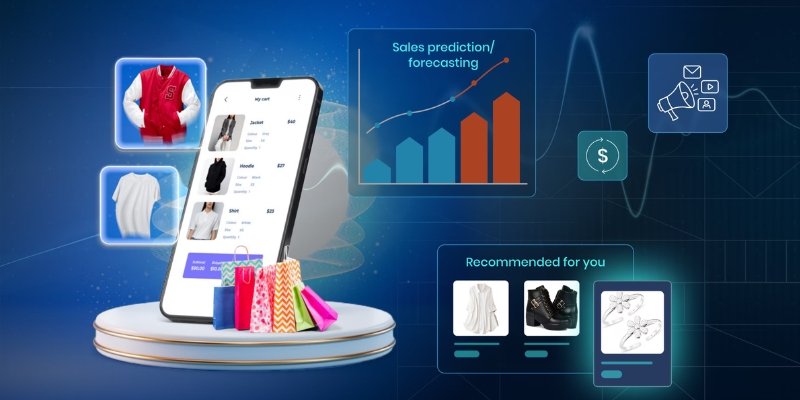
AI-driven analytics in ecommerce also power more accurate sales forecasting than traditional methods can. Rather than relying on historical averages, predictive models analyze real-time data from multiple sources to project future revenue.
Combined with market trend analysis, this enables businesses to adapt to changes faster - whether it’s a sudden shift in customer demand or a new competitor entering the space. The result is better decision-making, improved budgeting, and more stable growth.
Sales forecasting
Data-driven marketing insights
Finally, AI transforms marketing analytics into a continuously learning system. By combining predictive analytics with customer behavior analysis, marketers gain a full picture of what drives clicks, conversions, and loyalty.
These insights guide everything from ad targeting and content creation to campaign timing and channel selection. In short, AI-driven analytics in ecommerce doesn’t just report what happened - it reveals why it happened and what to do next, empowering ecommerce teams to optimize every decision for measurable impact.
Also read: AI For Marketing Automation in Ecommerce: The Ultimate Guide
AI-driven analytics has become a game-changer for ecommerce businesses, empowering them to move beyond basic tracking and manual reporting toward a truly intelligent decision-making framework. Let’s have a closer look at the various benefits brought about by AI-driven analytics.
Hyper-personalized customer experiences
AI has revolutionized how ecommerce brands connect with shoppers by delivering personalization at scale. Through continuous analysis of browsing habits, past purchases, and behavioral data, businesses gain deep consumer insights to craft more relevant experiences.
From product recommendations to dynamic pricing, AI ensures every interaction feels tailored and timely. When personalization aligns with customer intent, engagement rises - and so do conversions. This is how brands foster loyalty, build trust, and stand out in an overcrowded marketplace.
Unlocking real-time decision-making
In ecommerce, every second counts - and that’s where real-time analytics in online retail becomes a true game-changer. By processing data the moment it’s generated, AI gives businesses instant visibility into customer behavior, sales performance, and marketing ROI. Instead of waiting for reports, you can adjust campaigns or inventory on the fly.
For example, during a flash sale, real-time analytics can detect a sudden surge in demand for a specific product and trigger automatic restocking or ad budget shifts. This speed empowers teams to make smarter, faster decisions - boosting efficiency and responsiveness in a hypercompetitive digital marketplace.
Smarter conversion rate optimization
Ecommerce success depends on turning browsers into buyers, and conversion rate optimization with AI makes this process far more intelligent. By analyzing customer behavior, purchase intent, and on-site interactions, AI pinpoints exactly where users drop off - and what motivates them to buy.
Through continuous testing and automated reporting, machine learning systems optimize page layouts, pricing, and product recommendations for better conversion rate improvement. This data-driven precision eliminates guesswork, ensuring your online store evolves with your audience’s behavior and maximizes revenue at every step of the funnel.

Smarter conversion rate optimization
Predicting trends before they happen
Predictive analytics allows ecommerce businesses to plan ahead with confidence. By analyzing historical sales data and current market signals, AI forecasts future demand, customer preferences, and even potential risks. With AI’s foresight, businesses move from reactive to proactive, reducing waste and capitalizing on opportunities before competitors even spot them.
Smarter inventory and supply chain management
Balancing stock levels can make or break an ecommerce operation. AI brings precision to inventory optimization, ensuring you have the right products at the right time - without overstocking or missing sales. This minimizes holding costs, prevents shortages, and improves delivery efficiency. When powered by predictive modeling, your supply chain becomes more resilient and your operations more cost-effective, translating into better margins and customer satisfaction.
Clearer insights through data visualization
Data is only valuable if it’s understandable - and that’s what AI data visualization platforms deliver. These tools turn raw numbers into intuitive dashboards, highlighting trends, anomalies, and KPIs that matter most.
Using data visualization and automated reporting, teams can quickly identify performance gaps, track ROI, and make informed decisions without sifting through spreadsheets. Whether it’s visualizing customer lifetime value or campaign performance across multiple channels, AI-powered analytics ensures your data tells a story - clear, actionable, and tailored for decision-makers.
Adopting AI-driven analytics in ecommerce isn’t just about adding new tools - it’s about transforming how your ecommerce business understands and responds to data. Here’s a clear roadmap to make that transition smooth and effective.
Audit and organize your data
Before introducing AI, start by assessing your data foundation. Review your customer data, sales logs, product information, and operational metrics to ensure they’re complete, clean, and consistent. High-quality data is the lifeblood of any AI system - the more accurate and comprehensive it is, the more reliable your insights will be.
If data is scattered across platforms, consider centralizing it into a unified data warehouse or CRM system. This makes it easier for AI tools to access and analyze information holistically.
Identify key focus areas
Next, determine where AI can drive the biggest impact. Are abandoned carts eating into your revenue? Are you struggling with inventory optimization or inconsistent conversion rates? Pinpointing your main challenges helps you prioritize use cases with the fastest and most visible ROI.
For most ecommerce brands, the best starting points are personalized product recommendations, dynamic pricing, or predictive demand forecasting, depending on where data volume and opportunity align.
Choose the right AI tools
The market offers a wide range of AI analytics tools - from plug-and-play recommendation engines to more complex predictive modeling platforms. The key is selecting solutions that integrate smoothly with your current ecommerce ecosystem, including your CMS, CRM, and inventory systems.
If your business lacks in-house expertise, working with an experienced AI implementation partner can help ensure compatibility, scalability, and long-term value.
Train and integrate your systems
Once you’ve chosen your tools, the next step is training them on your data. Some AI models come pre-trained for ecommerce, but for deeper personalization and accuracy, fine-tuning is essential. This often involves data cleaning, model training, and custom integration into your workflows.
Remember: AI performs best when it’s fully embedded in your daily operations - not treated as a separate add-on. Integrating analytics dashboards and reports into existing processes ensures that insights turn into action.

Train and integrate your systems
Test, measure, and refine
AI isn’t a one-time setup; it’s an evolving system that gets smarter with use. After deployment, monitor key metrics such as sales growth, engagement rate, and inventory turnover. Use A/B testing and continuous optimization to refine your algorithms and improve personalization accuracy.
Over time, your AI system will learn from new data and deliver increasingly precise recommendations, enabling your business to stay agile and ahead of changing customer behavior.
While AI-driven analytics can revolutionize how ecommerce businesses make decisions, it’s not a frictionless journey. Like any transformative technology, it comes with challenges that must be anticipated and strategically managed to ensure sustainable success.
Ensuring data quality and consistency
AI models thrive on data - but only when that data is clean, accurate, and comprehensive. In many ecommerce operations, data comes from diverse sources such as websites, CRMs, social media platforms, and payment systems. When information is incomplete, duplicated, or inconsistent, it can distort insights and lead to misguided decisions.
To overcome this, businesses need robust data governance frameworks and frequent audits to validate the quality and relevance of their datasets. Investing in centralized data infrastructure also helps create a single source of truth for all analytics activities.
Complex system integration
Integrating AI tools into existing ecommerce ecosystems is rarely straightforward. Many businesses operate on legacy systems or fragmented platforms that don’t naturally communicate with modern AI solutions. This disconnect can delay implementation, increase technical debt, and create friction between teams.
Achieving seamless integration often requires custom APIs, middleware, or data pipelines to synchronize information in real time. Though this process demands upfront technical effort, it ensures smoother operations and unlocks the full value of AI analytics across departments.
Managing costs and ROI
Implementing AI-driven analytics in ecommerce can be costly - especially for smaller ecommerce businesses or those just starting their digital transformation journey. From software licensing and infrastructure setup to data processing and staff training, expenses can add up quickly.
The key is to take a phased implementation approach, focusing first on high-impact use cases such as predictive demand forecasting or personalized product recommendations. Demonstrating early value helps justify investment, sustain stakeholder support, and ensure a healthy return on analytics initiatives.
Navigating privacy and compliance
Data privacy regulations such as GDPR and CCPA impose strict standards on how customer information is collected, processed, and stored. Since AI systems often rely on large volumes of personal and behavioral data, ensuring compliance becomes both a legal and ethical priority.
Ecommerce brands must implement privacy-by-design principles, obtain transparent user consent, and continuously monitor compliance practices to maintain customer trust while leveraging AI-driven insights responsibly.
Addressing talent and expertise gaps
AI systems may automate data interpretation, but deploying and maintaining them still requires specialized skills in data science, engineering, and machine learning. For many ecommerce teams, this knowledge gap poses a significant barrier to effective adoption.
To bridge it, businesses can either invest in upskilling internal teams or partner with experienced AI solution providers who can handle technical complexity while transferring knowledge to in-house staff over time.
AI-driven analytics isn’t just reshaping ecommerce - it’s redefining how businesses compete. By turning raw data into actionable intelligence, brands can anticipate customer needs, optimize operations, and make faster, smarter decisions that drive measurable growth.
At Sky Solution, we help ecommerce businesses unlock the full potential of AI - integrating intelligent analytics, automation, and insight-driven strategy to elevate performance and profitability. Ready to see what AI can do for your ecommerce growth? Let’s build smarter solutions together.




.png&w=3840&q=75)