Lucia Lee
Last update: 06/11/2025
Generative AI is rewriting the rules of ecommerce. Once just a buzzword, it’s now the driving force behind smarter marketing, hyper-personalized shopping experiences, and faster content creation. In this post, we’ll dive into what generative AI really means for ecommerce, explore its top use cases, and uncover why it’s becoming the ultimate game-changer for online retailers.
Generative AI, often called Gen AI, refers to a branch of artificial intelligence capable of creating entirely new and original content - whether it’s text, images, videos, audio, code, or even 3D models - in response to human prompts. Unlike traditional AI systems that simply analyze or classify existing data, generative AI goes a step further by producing fresh, high-quality outputs that mimic human creativity.
At its core, Generative AI relies on advanced deep learning models that simulate the way the human brain learns and processes information. These models are trained on massive datasets, learning the patterns, relationships, and structures within them. When given a user’s input or natural language prompt, they use that learned knowledge to generate coherent and contextually relevant new content - from writing product descriptions and ad copy to designing visuals and simulating real-world scenarios.
Generative AI is revolutionizing ecommerce by making every part of the customer journey faster, smarter, and more creative. Here’s how ecommerce brands are already putting it to work:
Automated product descriptions
Writing hundreds or thousands of unique product descriptions is one of the most time-consuming parts of ecommerce - and it’s exactly where AI-generated product descriptions make a difference.
Generative AI tools can instantly craft detailed, persuasive, and SEO-friendly descriptions that match your brand tone and highlight key features. These models analyze product attributes, customer preferences, and trending keywords to generate content that feels authentic rather than robotic.
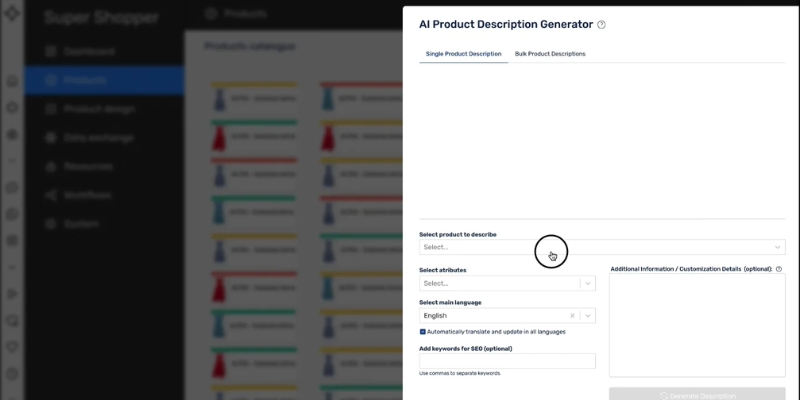
Automated product descriptions
Automated content generation
Keeping up with the constant need for blogs, emails, and ad copy can overwhelm even large teams. That’s where generative AI for marketing content and personalized ad copy generation come in.
By analyzing audience data and brand voice, generative AI tools can instantly produce campaign headlines, product spotlights, and social media posts that sound like they were written by a skilled marketer. They can also tailor messaging for different customer segments - say, emphasizing deals for price-sensitive buyers or exclusivity for premium shoppers.
Personalized product recommendations
Today’s shoppers expect personalized experiences - and generative AI in ecommerce makes that expectation easy to meet. These systems study browsing history, purchase behavior, and even contextual cues like location or time of day to predict what customers are most likely to buy next.
Generative AI doesn’t just display “similar items” - it can generate dynamic, personalized product recommendations or style suggestions that feel custom-made. For example, if a user is shopping for running shoes, the AI might recommend compatible gear or exclusive training plans. This level of personalization increases engagement, average order value, and customer satisfaction, all while making the buying journey feel intuitive and helpful.
Customer service automation
Modern AI chatbots for customer support powered by generative AI can do far more than answer basic FAQs. They engage customers in natural, human-like conversations using context and tone that reflect your brand’s personality.
These chatbots handle returns, track orders, and assist with product recommendations 24/7 - often resolving issues faster than human agents. For more complex situations, they seamlessly escalate to a live representative with full conversation history for a smooth transition. By combining speed, accuracy, and empathy, AI-powered support not only reduces costs but also enhances customer trust and loyalty.
Also read: AI for Personalized Customer Service: The Ultimate Guide
Image and video generation
Going beyond text generation, generative AI in ecommerce can produce high-quality visuals that traditionally require photo shoots and editing sessions. Whether you want AI image generation for product catalogs or AI video generation for ecommerce, just provide clear prompts describing the creatives you want, and generative AI tools will produce them in seconds.
Automated visual content creation helps you refresh creative assets quickly, reduce production costs, and maintain visual consistency across every channel.

Image and video generation
Visual search and virtual try-on
Generative AI in ecommerce has brought a new level of interactivity to the online shopping experience. Shoppers can now upload an image and instantly discover visually similar products, thanks to advanced visual search tools.
AI also powers virtual try-on features that let users “see” how clothes, accessories, or cosmetics would look on them in real time. These models generate realistic overlays and adapt to user photos, lighting, and movement.
By enabling customers to visualize products before purchasing, ecommerce stores improve confidence, reduce return rates, and create a more engaging, immersive shopping journey.
Product design
Generative AI in ecommerce isn’t just transforming marketing - it’s helping brands innovate faster. By analyzing design data, customer feedback, and sales performance, AI systems can generate new product ideas that align with market trends. This data-driven creativity ensures that new designs align closely with customer expectations and emerging styles.
For instance, fashion brands can use AI to create fresh patterns or color palettes, while home décor companies can explore 3D model concepts before finalizing designs. These AI-assisted concepts give human designers a starting point for creative exploration, speeding up time-to-market and increasing innovation capacity.
Dynamic pricing
Setting the right price at the right time is a delicate balancing act, but it can be made easier with dynamic pricing powered by generative AI. Generative AI can analyze historical sales data, competitor prices, and even external signals like seasonality or demand spikes to simulate various pricing scenarios.
Based on these insights, it generates real-time recommendations for optimal pricing strategies - whether it’s offering discounts to boost slow-moving stock or adjusting prices dynamically during high demand.
Demand forecasting and inventory management
Generative AI in ecommerce is redefining how businesses predict demand and manage stock. It studies years of sales history, seasonal trends, and customer preferences to forecast future buying patterns with exceptional accuracy.
These models can simulate different scenarios - for instance, predicting how a viral social media campaign might affect product demand or how external factors like weather or holidays might shift sales. This proactive demand forecasting ensures products are available when needed, helps avoid costly overstocking, and minimizes waste, keeping operations lean and efficient.

Demand forecasting and inventory management
Customer research and analysis
Understanding customers deeply requires more than just collecting data - it requires transforming it into insights. Generative AI in ecommerce excels at this by processing reviews, social media posts, and survey responses to identify consumer insights and enable accurate trend prediction.
It can summarize common themes, detect emerging preferences, and highlight potential product improvements. For example, it might discover that customers love a specific material or color trend before it becomes mainstream. This empowers ecommerce businesses to make smarter product, marketing, and merchandising decisions - staying one step ahead of changing customer behavior.
Fraud detection
Online fraud continues to evolve, but so does AI. Generative models can simulate fraudulent scenarios, helping systems detect anomalies in transactions, account activity, or login behavior before they escalate.
Unlike traditional rules-based systems, generative AI learns continuously, adapting to new threats in real time. It not only flags suspicious activity but also minimizes false positives, keeping legitimate customers’ experiences seamless. With intelligent fraud prevention in place, ecommerce businesses can safeguard both revenue and reputation while maintaining customer trust.
It’s no exaggeration that generative AI is revolutionizing the ecommerce landscape. From greater operational efficiency to enhanced customer engagement, let’s explore how its benefits span every stage of the customer journey and business process.
Faster and more scalable marketing execution
With AI-driven automation, ecommerce companies can rapidly generate personalized marketing materials for different audiences, channels, or seasons. What once required large creative teams can now be done with a few prompts, enabling faster campaign launches and more agile responses to market trends. This scalability gives brands a competitive edge, ensuring they stay visible and relevant even in fast-changing environments.
Hyper-personalized customer experiences
Personalization lies at the core of AI’s impact on ecommerce. Generative AI in ecommerce analyzes vast amounts of behavioral data to create tailored product recommendations, targeted email campaigns, and dynamic website experiences. These individualized interactions make customers feel understood and valued, which in turn boosts satisfaction, loyalty, and conversion rates.

Hyper-personalized customer experiences
Greater operational efficiency and cost reduction
Automation powered by generative AI minimizes manual labor across multiple functions. From automating product categorization and content creation to optimizing inventory and logistics, AI streamlines workflows and reduces errors. This efficiency translates to lower operational costs, faster fulfillment, and improved profitability.
Data-driven insights for better decision-making
Generative AI doesn’t just automate - it illuminates. By analyzing vast datasets, it reveals consumer trends, predicts demand, and uncovers new growth opportunities. These insights enable ecommerce leaders to make informed decisions about pricing, marketing, and inventory strategies. Instead of relying on intuition, businesses can base their actions on accurate, real-time intelligence, driving both agility and long-term competitiveness.
Increased sales and revenue growth
AI directly fuels sales by optimizing every touchpoint in the buying journey. Personalized recommendations encourage upselling and cross-selling, dynamic pricing maximizes revenue potential, and optimized content increases search visibility and conversion rates. Together, these enhancements can significantly raise average order values and reduce cart abandonment, leading to sustained revenue growth.
Reduced manual workload and improved productivity
Generative AI in ecommerce handles repetitive and time-consuming tasks like data entry, routine customer interactions, and basic content generation, freeing human employees to focus on creativity, innovation, and strategy. This not only boosts productivity but also improves employee satisfaction, as staff can dedicate their time to higher-value tasks that require human insight and empathy.
Now that you’ve understood the what and why of generative AI in ecommerce, you may be wondering how to integrate it into your operations. To make sure your generative AI initiatives deliver measurable impact, follow these structured steps.
Assess current operations and identify AI opportunities
Start by examining how your ecommerce business currently functions - from product listing and marketing to customer support and fulfillment. Identify pain points such as manual content creation, inconsistent customer experiences, or inefficiencies in demand forecasting.
Once you’ve mapped your processes, pinpoint where generative AI can add the most value. Evaluate use cases based on impact potential, technical feasibility, and ROI.
Define clear objectives and KPIs
A successful generative AI in ecommerce strategy begins with clear goals. Establish specific, measurable objectives that align with your overall business strategy - for instance, reducing content creation time by 50% or increasing conversion rates by 10%.
Define key performance indicators (KPIs) to track your progress, such as click-through rates, average order value, or customer satisfaction scores. Setting baseline metrics before implementation ensures you can accurately measure improvement later.
Choose the right AI tools and partners
Selecting the right generative AI tools is crucial for scalability and performance. Evaluate available platforms and vendors based on functionality, integration capabilities, customization options, and cost efficiency.
If your business requires more tailored solutions, consider partnering with experienced AI development firms or consultants who specialize in ecommerce. They can help you design, train, and deploy models that understand your brand voice, product catalog, and customer base.

Choose the right AI tools
Build a robust data strategy and infrastructure
Generative AI runs on data - and the quality of your data determines the quality of your AI’s output. Assess how your business currently collects, stores, and processes data. Identify any gaps, inconsistencies, or outdated information, and create a plan to improve data quality.
Invest in modern data infrastructure, including cloud storage, data pipelines, and analytics tools, to ensure scalability and security. A strong data foundation not only enhances AI accuracy but also ensures compliance with data protection regulations.
Implement AI solutions incrementally
Instead of rolling out generative AI across all departments at once, start small with pilot projects in high-impact areas such as personalized recommendations, content generation, or automated customer support.
Monitor performance closely, gather feedback from users, and refine your approach based on results. Once these pilots demonstrate measurable success, gradually expand adoption to other areas of your ecommerce operations. This incremental approach minimizes risk and promotes smoother integration.
Also read: AI in Ecommerce: The Successful Case Study of BettaMax
Train and customize AI models
Generic AI models rarely deliver optimal results out of the box. Train your chosen generative AI tools using your own ecommerce data, including product information, brand tone, and customer interactions. This ensures that the AI understands your unique business context and generates outputs that align with your brand identity.
Regular retraining is also essential to maintain accuracy as your product catalog and customer behaviors evolve over time.
Test, evaluate, and refine
Before full-scale deployment, rigorously test your AI systems in controlled environments. Evaluate their impact on key areas like user experience, response accuracy, and operational efficiency.
Use A/B testing to compare AI-driven outcomes against traditional methods. Gather both quantitative metrics and qualitative feedback from staff and customers to ensure the AI enhances - rather than complicates - workflows.
Deploy and monitor continuously
Once your generative AI tools are ready, deploy them gradually across live systems. Continuously monitor performance through analytics dashboards and user feedback loops.
Be prepared to make iterative improvements, fine-tune prompts, and retrain models based on new data or evolving customer expectations. Ongoing monitoring helps detect issues early and maintain consistent, high-quality output.
While generative AI is transforming ecommerce with automation and personalization, it also introduces new complexities that businesses must address for effective implementation.
Data quality and availability
Generative AI’s effectiveness depends entirely on the quality and quantity of the data it processes. Poor or incomplete data can lead to inaccurate outputs, irrelevant recommendations, or biased content. Unfortunately, ecommerce data often decays quickly - customer information becomes outdated, preferences change, and behaviors evolve.
Maintaining “clean” and updated datasets requires continuous monitoring, validation, and investment in robust data management systems. Without it, even the most advanced AI models can produce flawed or misleading results.
Integration complexity
Integrating AI with existing ecommerce infrastructure is often one of the most significant hurdles. Ecommerce systems must connect multiple platforms - such as CRM or ERP - each storing data in different formats. Ensuring that these systems communicate seamlessly requires technical expertise, API configuration, and sometimes custom middleware.
For businesses without in-house AI specialists, the integration process can be time-consuming and expensive. Poor integration can also limit AI’s scalability and reliability, reducing its long-term value.
Ethical and privacy concerns
Generative AI relies heavily on customer data to personalize shopping experiences. However, this dependence raises serious privacy concerns. Collecting and analyzing behavioral data can feel intrusive to customers, especially if transparency is lacking.
There are also ethical questions about fairness - for example, dynamic pricing that charges different users varying prices for the same product, or recommendation engines that unintentionally reinforce demographic biases.
To build trust, ecommerce brands must clearly communicate how data is collected and used, offer opt-out options, and ensure compliance with privacy regulations like GDPR and CCPA.

Ethical and privacy concerns
Transparency and explainability
Many generative AI models function as “black boxes,” making it difficult to understand how decisions - such as pricing changes, recommendations, or fraud alerts - are made. When customers can’t see the logic behind AI-driven outcomes, trust can erode quickly.
For ecommerce, explainable AI (XAI) solutions are becoming increasingly important. They allow businesses to interpret how the AI reached certain conclusions and provide customers with clear reasoning behind decisions, improving credibility and compliance.
Security risks and data breaches
Because ecommerce AI systems often handle sensitive personal and financial data, they become prime targets for cyberattacks. A single breach could expose thousands of customer records, leading to financial loss and severe reputational damage. Businesses must encrypt data, limit access, and regularly assess vulnerabilities to protect against unauthorized use or leaks.
High implementation costs
Deploying and maintaining generative AI in ecommerce solutions can be expensive. Costs include purchasing software licenses, cloud infrastructure, computational power, and hiring skilled AI professionals. For small and medium-sized ecommerce businesses, these upfront investments can be prohibitive.
Even after deployment, AI models require continuous updates, retraining, and fine-tuning, all of which add to operational costs. Starting with smaller pilot projects and scaling gradually is often the most sustainable approach.
Over-reliance on automation
While AI can automate routine tasks, over-dependence can lead to errors and reduced human oversight. For example, AI-generated content might occasionally produce inaccurate or inappropriate language, damaging brand image.
Human review remains essential to ensure quality control, brand consistency, and ethical decision-making. The most effective ecommerce strategies balance AI automation with human creativity and judgment.
Measuring ROI and performance
Quantifying the return on investment from generative AI can be difficult. While AI can boost engagement and efficiency, linking those outcomes directly to financial gains isn’t always straightforward.
For example, measuring the exact contribution of AI-driven personalization to revenue growth requires detailed analytics and tracking mechanisms. Businesses must define clear performance metrics from the start to ensure that their AI initiatives deliver measurable, strategic value.
Generative AI in ecommerce isn’t just the next trend - it’s a transformation in how businesses create, personalize, and sell. From automating content and enhancing customer experiences to forecasting demand with precision, it’s redefining what efficiency and innovation look like in online retail.
If you’re ready to take your ecommerce strategy to the next level, Sky Solution’s generative AI solutions can help you turn automation into real growth. Contact us now for a free consultation.