Lucia Lee
Last update: 12/11/2025
Picture the everyday systems that respond instantly without overthinking - like a thermostat adjusting temperature or an automated support bot replying to routine questions. These are simple reflex agents, one of the foundational building blocks of artificial intelligence.
For businesses, understanding simple reflex agents isn’t just academic. They power real, practical automation that improves efficiency without requiring complex reasoning or significant infrastructure. Keep reading to explore everything you need to know about simple reflex agents, from what they are and how they work to where they’re useful and where their limitations begin.
A simple reflex agent is the most basic yet foundational type of artificial intelligence agent. It operates by reacting directly to the environment state through predefined condition-action rules - for example, “if the temperature drops below 20°C, then turn on the heater.” This approach means the agent responds instantly to current conditions without analyzing past inputs or predicting future outcomes.
Unlike more advanced AI models that rely on learning or reasoning, a simple reflex agent has minimal memory - it doesn’t store historical data or anticipate what might happen next. Its decisions are based entirely on what it can currently perceive, making it fast, efficient, and reliable in predictable, fully observable environments.
While simple reflex agents can’t handle complex, unpredictable scenarios, they remain essential building blocks in automation systems and still play a role within larger, multi-agent agent systems that combine reactive and intelligent decision-making.
A simple reflex agent is built from a small set of tightly coupled parts that together enable instant, rule-based responses. Before diving into how it works, let’s first understand what role each component plays:
Now let’s explore how simple reflex agents work behind the scenes:
Step 1: Perceiving the environment
The process begins with environment sensing. Sensors detect real-time changes - like a rise in temperature, the presence of motion, or dirt on a surface - and send this information directly to the processor. Since the agent doesn’t store past data, it depends entirely on the accuracy of this instant sensory input.
Step 2: Matching conditions to rules
The processor evaluates the current input against its internal library of condition-action rules. Using the stimulus-response mechanism, it identifies which rule corresponds to the current state. For example: “If temperature < 22°C → activate heater” ; “If motion detected → turn on lights”. This evaluation is deterministic - there’s no guessing, reasoning, or learning involved.
Step 3: Selecting and executing an action
Once the matching rule is found, the processor sends an execution command to the appropriate actuator. The actuator then performs the designated operation, whether that’s moving, switching, cleaning, or signaling another system component.
Step 4: Returning to the monitoring state
After executing the action, the agent immediately returns to a monitoring mode, ready to sense the next environmental change. Since there’s no memory or feedback validation, the cycle repeats continuously and independently, delivering consistent, real-time responsiveness.
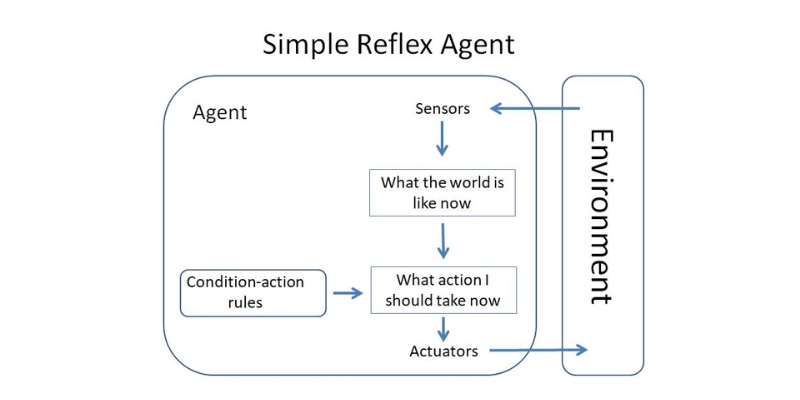
How simple reflex agents work
Simple reflex agents are all around us - quietly automating routine decisions and enabling devices to act instantly without human input. Let’s have a closer look at the areas where simple reflex agents are valuable.
Smart thermostats and climate control
One of the most familiar applications of simple reflex agents is in climate control systems. Smart thermostats operate purely on condition-action rules: when the room temperature drops below a set point, the heating system turns on; when it rises above, the system shuts off.
This real-time processing ensures comfort and energy efficiency without any user input. For instance, if the preset temperature is 22°C, the thermostat instantly activates heating when the temperature dips to 21°C and switches it off once the optimal level is restored.
Advanced models expand this logic to include time-based or situational rules - like “if it’s 6 p.m. in winter, raise the temperature,” or “if it’s noon in summer, activate the cooling system.” Such systems don’t need complex reasoning or memory; they simply respond to the current environment state using predefined rules.

Smart thermostats
Automated customer service systems
Many automated chatbots and email filters also function as simple reflex agents. A password-reset bot, for example, detects phrases like “forgot password” and immediately sends reset instructions. Similarly, spam filters flag and move emails containing suspicious keywords or blacklisted senders to the junk folder.
These systems operate entirely on condition - action logic: if the input matches a known trigger, a pre-programmed response follows. While they lack the contextual understanding of advanced conversational AI, they deliver quick, consistent service for well-defined tasks.
Also read: Top 10 Applications of Agentic AI across Industries
Home automation systems
Smart homes thrive on reflexive automation. Devices like smoke detectors, motion-activated lights, and automatic doors use simple reflex logic to perform their functions.
A smoke detector senses smoke particles and immediately triggers an alarm. An automatic door detects motion and opens right away. These are direct applications of the stimulus-response mechanism - no delays, no deliberation.
By using straightforward condition-action mapping, home automation systems provide safety, convenience, and energy efficiency while operating entirely autonomously.
Traffic light management systems
Traffic control is another classic example where simple reflex agents deliver tremendous value. Modern adaptive traffic systems use embedded sensors to monitor vehicle flow and adjust signals accordingly.
When a sensor detects cars waiting at an intersection, the agent extends the green light. When traffic clears, it switches to red. This real-time processing prevents unnecessary delays, reduces congestion, and improves safety without relying on predictive modeling.

Traffic light management systems
Industrial and safety systems
In industrial environments, simple reflex agents are vital for safety and stability. Factories and chemical plants use them to monitor temperature, pressure, and flow rates. If any value exceeds safe thresholds, the system instantly triggers protective actions such as releasing pressure, shutting down machinery, or activating cooling systems.
Because their responses are rule-based and deterministic, engineers can test and validate these systems thoroughly, ensuring reliability during critical operations. This predictability makes them indispensable in environments where even a second’s delay could lead to disaster.
Consumer electronics
Your everyday devices rely on simple reflex agents more than you might realize. Smartphones adjust screen brightness automatically based on ambient light levels. When light intensity decreases, sensors signal the processor to dim the display; when it increases, the screen brightens again.
Battery management systems work the same way. When charge levels fall below a threshold, the phone automatically enables power-saving mode - another instance of real-time processing driven by condition-action rules.
Smart home gadgets like motion sensors, security alarms, and automated garage doors operate similarly, providing instant responses without user commands or memory-based computation.
Medical device applications
In healthcare, the reliability and speed of simple reflex agents can save lives. Pacemakers, for example, detect irregular heart rhythms and immediately deliver electrical impulses to correct them. Ventilators constantly monitor a patient’s breathing pattern and adjust airflow the moment irregularities appear.
Since these systems rely on strict, predefined rules rather than adaptive algorithms, their behavior is predictable, testable, and certifiable - an essential trait for safety-critical medical equipment.
Examples of simple reflex agents in robotics
Robotics offers some of the most practical applications of simple reflex agents. Examples of simple reflex agents in robotics include both domestic robots and industrial robots. A robotic vacuum cleaner follows the rule “if dirt detected → activate brush,” while a warehouse robot may follow “if correct barcode detected → pick item.” These rules enable robots to perform repetitive tasks such as cleaning, sorting, or item retrieval with unmatched speed and precision.
This real-time processing allows robots to execute tasks efficiently without the complexity of learning models or data storage. Although limited in adaptability, these agents remain the backbone of automation in manufacturing, logistics, and service robotics.
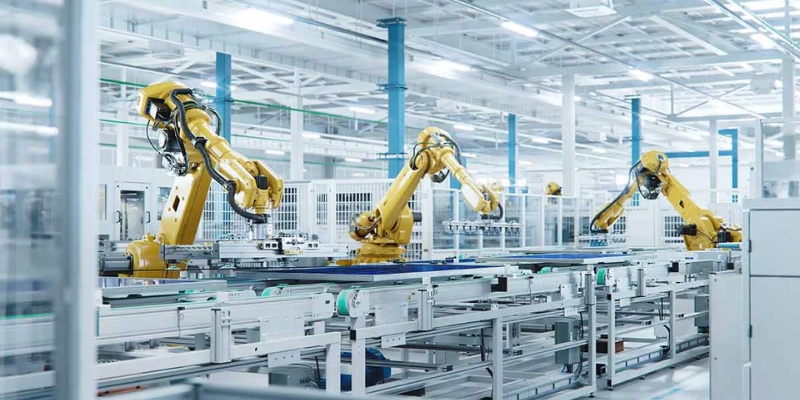
Simple reflex agents in robotics
Simple reflex agents may be the most basic among all types of AI agents, but their simplicity translates into powerful advantages for many business and industrial applications.
Speed and real-time responsiveness
One of the most notable advantages of simple reflex agents is their near-instant reaction time. Because they operate purely on direct condition-action rules, these agents can respond to environmental changes within milliseconds. This allows them to function seamlessly in time-critical applications such as industrial automation, motion-activated security systems, or medical monitoring devices.
Unlike goal-based AI agents, which must evaluate multiple outcomes before deciding, simple reflex agents bypass complex reasoning altogether. Their stimulus-response mechanism ensures immediate execution, making them ideal where speed is more important than sophisticated cognition.
Cost-effectiveness and resource efficiency
Simple reflex agents are also remarkably cost-effective, primarily due to their lightweight computational design. They don’t require powerful processors, extensive memory, or large datasets to function, making them suitable for embedded systems such as thermostats, vending machines, and automatic doors.
Their minimal reliance on energy and hardware resources allows organizations to deploy them widely without incurring high operational costs. Compared to more advanced AI systems, simple reflex agents can be installed and maintained at a fraction of the cost - a significant advantage for businesses aiming to scale automation affordably.
Predictable and reliable behavior
Predictability is one of the defining strengths of simple reflex agents. Since they follow fixed if-then rules, their behavior remains consistent and transparent, producing identical outputs for identical inputs. This makes them particularly valuable in safety-critical or structured environments such as traffic control systems, climate regulation, and elevator operations.
The absence of adaptive learning or evolving algorithms ensures there are no unexpected behaviors, which could compromise safety or efficiency. This high level of reliability makes them a trusted choice in industries where system failure or unpredictability is unacceptable.
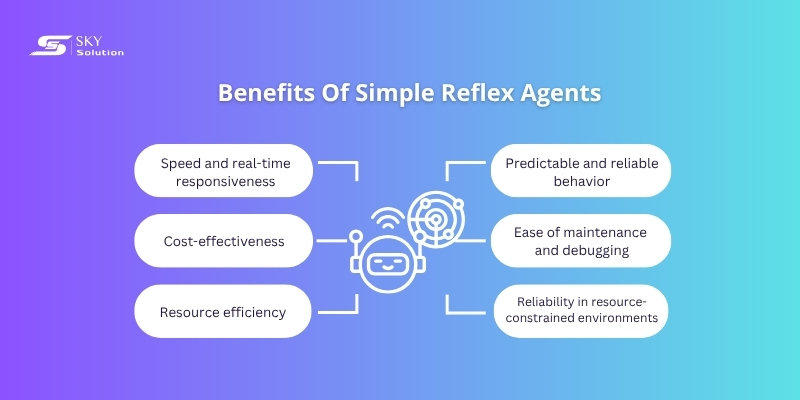
Benefits of simple reflex agents
Ease of maintenance and debugging
Maintenance and troubleshooting are straightforward with simple reflex agents because their rule-based logic is both explicit and transparent. Engineers can easily pinpoint which condition triggered a particular action, reducing the time and effort needed to diagnose issues.
Unlike goal-based AI agents, which often require retraining or complex model updates, simple reflex agents can be repaired or adjusted by simply modifying specific rules. This simplicity lowers maintenance costs, minimizes downtime, and allows organizations to maintain consistent operational performance without the need for specialized AI expertise.
Reliability in resource-constrained environments
Finally, simple reflex agents excel in low-resource environments where other AI systems might struggle. Their minimal processing and memory requirements allow them to operate efficiently even on devices with limited computing power.
In comparison with model-based reflex agents, they consume significantly fewer resources while still maintaining dependable performance. This resilience enables them to continue functioning reliably even when more complex systems fail, making them a trusted choice for businesses that require uninterrupted functionality in critical or energy-limited environments.
While simple reflex agents excel in speed, predictability, and cost-effectiveness, their design simplicity also introduces serious constraints. Below are the main reasons why simple reflex agents are insufficient for real-world AI.
Lack of adaptability and learning
At the heart of the issue lies the agent’s complete dependence on predefined rules. A simple reflex agent in agentic AI follows static condition-action mappings that cannot adapt to changing situations or learn from new experiences. Without mechanisms for memory storage or pattern recognition, these agents cannot improve performance over time or handle scenarios beyond their initial programming.
No memory and limited context awareness
Simple reflex agents have no capacity for long-term memory or contextual understanding. Their decisions depend solely on the current sensory input, disregarding any past events that could influence better outcomes. This makes them incapable of performing tasks that require remembering previous states-such as tracking locations in a warehouse or recognizing repeated errors in a process.
Since they operate in an immediate perception-action cycle, they cannot establish connections between previous and future actions. As a result, even repeated exposure to similar conditions doesn’t lead to improvement, making their reactive behavior ineffective in complex or unpredictable settings.
Inflexible rule-based design
The rigid, rule-based agent architecture of simple reflex agents is both their strength and their weakness. Every possible behavior must be explicitly encoded in advance, meaning that if an environment changes, the existing rules might become irrelevant or counterproductive.
For example, a climate-control agent programmed for fixed temperature thresholds may waste energy if seasonal conditions shift. In such cases, human intervention is required to manually adjust or rewrite the rules. This dependence on human oversight prevents scalability and reduces the efficiency that automation promises.
Vulnerability to exploitation and errors
The predictability that makes simple reflex agents reliable also exposes them to exploitation and false decision-making. Because their reactive behavior is entirely rule-driven, attackers who understand those rules can manipulate environmental conditions to trigger unintended responses.
A security system, for example, could be deceived by signal interference or sensor spoofing, leading to unauthorized access. Similarly, these agents struggle with false positives or negatives - like a smoke detector misinterpreting steam as fire - since they cannot differentiate between contextually similar stimuli. Their inability to reason under uncertainty or detect sensor anomalies highlights a significant flaw in the perception-action cycle they rely upon.
Performance limitations in complex environments
Simple reflex agents assume that their sensory input perfectly reflects reality. However, in most real-world applications, sensor data is often incomplete, noisy, or ambiguous. Without reasoning or probabilistic inference capabilities, the agent cannot compensate for missing information. This leads to poor performance in partially observable or dynamic environments - conditions that more advanced AI systems, like model-based or learning agents, handle effectively. In contrast, simple reflex agents falter when the situation requires balancing multiple factors or evaluating long-term goals, revealing the inherent limitations of their reactive behavior.
Simple reflex agents may be the simplest form of artificial intelligence, but their speed, reliability, and efficiency still make them invaluable for automation, safety, and control systems. However, as businesses move toward smarter, more adaptive AI solutions, it’s clear that real-world applications demand more than reactive rule-following.
That’s where Sky Solution comes in. Our AI agent development solutions go beyond basic reflex models = designing intelligent, adaptable systems that understand context, learn from data, and act with precision.
Ready to build smarter AI agents that elevate your business performance? Contact us now and let’s create intelligent systems that think, learn, and deliver results.




.jpg&w=3840&q=75)