Lucia Lee
Last update: 17/11/2025
As AI continues to transform the way businesses operate, different types of AI agents are emerging to handle everything from customer service to logistics optimization. Among these, utility-based agents stand out for their ability to do what works best based on defined goals and measurable outcomes - not just react to conditions like simpler AI models. Keep scrolling down to understand what utility-based agents are, how they work, and why they’re becoming an essential part of modern business automation.
Utility-based agents are a sophisticated type of AI agents designed to make decision making more nuanced and effective. Unlike simpler systems that simply react to stimuli or pursue predefined objectives, these agents evaluate multiple possible actions to select the one that maximizes overall satisfaction or benefit, even in uncertain or complex environments.
By applying principles from decision theory for AI agents, utility-based systems can weigh trade-offs, balance competing priorities, and handle scenarios where no perfect solution exists. Their flexibility makes them ideal for tasks where quality of the outcome is as important as achieving it.
Difference between Utility-based agents and Goal-based agents
When it comes to AI agent types, it’s important to differentiate utility-based agents from goal-based agents. The distinction lies in utility vs goals in AI: While goal-based agents focus solely on reaching a target state, utility-based agents evaluate how well each potential outcome meets their objectives.
Instead of asking, “Did I achieve the goal?” a utility-based agent asks, “Which action provides the best overall result across all my priorities?” This added layer of evaluation enables more refined and rational decision making, making utility-based agents better suited for complex, real-world business scenarios where trade-offs and uncertainty are unavoidable.
Utility-based agents are composed of several interconnected components, each playing a crucial role in enabling rational decision making and maximizing outcomes in complex environments. Here’s a breakdown of the key elements:
Utility function
At the heart of a utility-based agent lies the utility function, a mathematical representation of the agent’s preferences. This function assigns numerical values to each possible outcome, reflecting how desirable or beneficial that outcome is. By evaluating potential actions through this function, the agent can choose the one that maximizes overall utility.
For instance, in an autonomous vehicle, the utility function may balance safety, speed, fuel efficiency, and passenger comfort, helping the agent determine the optimal course of action.
State space
The state space defines all possible conditions or scenarios the agent might encounter. By understanding these states, the agent can anticipate consequences and plan its actions strategically.
In practical applications, such as self-driving cars, the state space may include the vehicle’s location, speed, traffic conditions, and weather, allowing the agent to reason effectively about its environment.
Actions
Actions are the set of all operations the agent can take to move from one state to another. The action selection mechanism evaluates these options using the utility function, ensuring that each decision advances the agent toward higher utility.
Transition model
The transition model describes how each action influences the agent’s movement through the state space. It predicts the probability of reaching a new state after a particular action, allowing the agent to make informed decisions under uncertainty. For example, accelerating might increase speed but consume more fuel, while braking enhances safety but reduces efficiency. Transition models are particularly important in dynamic or unpredictable environments.
Sensors
Sensors enable the agent to perceive its surroundings. These can be physical, like cameras or temperature sensors, or digital, such as API feeds or system logs. Sensor data feeds into the agent’s internal model, helping it monitor real-time conditions and adapt to changes effectively.
Internal model
The internal model is the agent’s mental map of the environment, continuously updated using sensor inputs. It allows the agent to infer unseen or future states, supporting more accurate decision making. Advanced internal models may incorporate probabilistic reasoning to handle uncertainty in complex scenarios.
Actuators
Actuators allow the agent to act on the environment. Physical actuators include robotic arms or autonomous vehicles, while digital actuators involve software outputs, API calls, or chatbots. They execute the chosen actions, completing the cycle from perception to rational action.
Utility-based agents operate through a structured process that allows them to make rational decisions even in complex or uncertain environments. But how exactly does utility-based decision making work? Here’s a step-by-step look at how utility-based agents work behind the scenes.
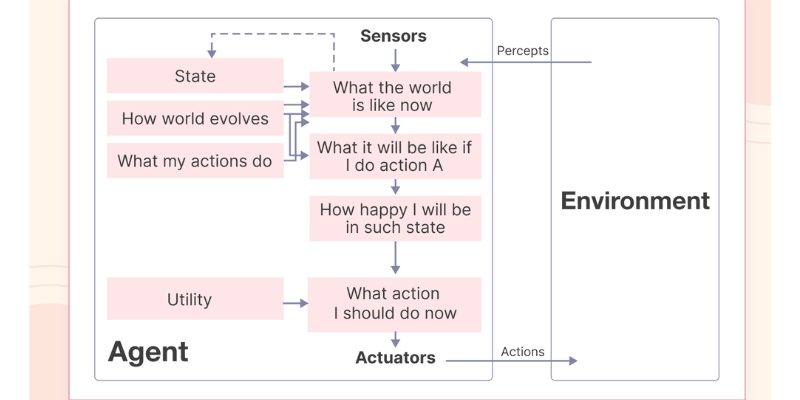
How utility-based agents works
Perception of the agent environment
The first step involves gathering information about the agent environment. Using sensors - whether physical, like cameras and thermometers, or digital, like APIs and system logs - the agent collects data about its current state and surroundings. This real-time perception forms the foundation for all subsequent decisions.
Internal modeling
Once the environment is perceived, the agent updates its internal model to reflect current conditions. This model helps the agent simulate potential scenarios, track dynamic changes, and infer hidden variables. Accurate internal modeling enables the agent to reason effectively about possible outcomes.
Action generation
The agent identifies all possible actions it can take in its current state. Advanced agents often employ search, optimization algorithms, or multi-criteria optimization in agents to generate feasible options, ensuring a balance between competing priorities and potential trade-offs. This step forms the basis of how AI agents evaluate choices.
Outcome prediction
For each potential action, the agent uses its transition model to anticipate the resulting state. This involves predicting the likelihood of different outcomes, accounting for environmental dynamics, uncertainty, and constraints. Predictive capability ensures the agent considers not just immediate effects but longer-term consequences of each decision.
Expected utility calculation
Next, the agent applies the utility function in AI to evaluate the desirability of each predicted outcome. This expected utility calculation quantifies how beneficial each action is, considering all relevant criteria, and is central to utility modeling for autonomous systems. Higher utility scores indicate more favorable choices according to the agent’s objectives.
Action selection
The agent compares utility scores across all potential actions and selects the one with the highest value. This step ensures that the agent’s behavior aligns with its performance goals, using the performance measure for AI agents as a benchmark for success.
Action execution and feedback
Once the optimal action is chosen, the agent carries it out in the environment. After execution, the agent observes the new state, updates its internal model, and evaluates whether the outcome aligns with expectations.
Learning and adaptation
Advanced utility-based agents can refine their decision-making over time. By analyzing discrepancies between predicted and actual outcomes, the agent can update its utility function and transition models, improving performance in future decisions. This continuous learning ensures the agent adapts to changing conditions and maintains optimal operation.
Utility-based agents are increasingly transforming industries by making rational decisions across complex, dynamic environments. Here’s a detailed look at some of the most impactful real-world applications:
Autonomous vehicles
Self-driving cars are perhaps the most high-profile example of utility-based agents in action. Instead of just aiming to reach a destination (goal-based), these agents weigh multiple factors such as safety, efficiency, fuel consumption, passenger comfort, and traffic conditions.
For instance, an autonomous vehicle might decide to take a slightly longer route to avoid heavy traffic or inclement weather, maximizing overall utility rather than merely minimizing travel time.

Autonomous vehicles
Personalized recommendations
E-commerce platforms, streaming services, and digital content providers use recommendation systems powered by utility-based agents to enhance user experience and drive engagement. These agents analyze past behavior, preferences, browsing history, and even contextual factors like time of day to suggest products or content with the highest utility for each user.
Netflix, Amazon, and Spotify, for instance, continuously refine their agents’ utility functions to offer personalized picks that adapt to changing user preferences, balancing convenience, relevance, and engagement metrics.
Supply chain and logistics optimization
In complex supply networks, utility-based agents are used to optimize resource allocation, inventory, and delivery routes. By evaluating multiple objectives - such as minimizing costs, reducing delivery times, managing risk, and maintaining service quality - agents make decisions that improve operational efficiency.
Amazon’s supply chain, for example, employs these agents to balance warehouse stock levels, route planning, and delivery priorities. These systems continuously update based on real-time changes in demand, ensuring the supply chain adapts dynamically to shifting market conditions.
Energy management
Utility-based agents are crucial in smart grids and building energy management systems, where they optimize energy usage while balancing cost, sustainability, and comfort. The agents monitor consumption, predict demand, and allocate resources intelligently, considering factors like weather forecasts and renewable energy availability.
For example, during periods of renewable energy surplus, the system might prioritize clean energy use even at higher short-term costs, while during shortages, reliability and grid stability take precedence. This approach helps reduce costs, enhance environmental impact, and maintain consistent service.

Energy management
Financial trading and investment
Modern financial markets leverage utility-based agents for multi-criteria decision making in high-frequency trading and investment strategies. These agents evaluate potential returns, risk, liquidity, and regulatory compliance simultaneously.
For instance, an AI trading system might pass up a high-return opportunity if it increases portfolio risk beyond acceptable thresholds, or it might take a smaller, safer trade to maintain balance. During volatile market conditions, agents dynamically adjust their utility functions to prioritize capital preservation over aggressive returns, enabling more intelligent, context-sensitive trading decisions.
Healthcare and medical resource management
In healthcare, utility-based agents assist in decision-making for patient prioritization, treatment planning, and resource allocation. During crises like the COVID-19 pandemic, hospitals used these agents to weigh survival probabilities, treatment costs, and resource availability, providing rankings to guide human decision-makers.
In routine care, utility-based AI supports personalized treatment plans, balancing effectiveness, side effects, patient quality of life, and cost considerations. These applications illustrate the power of utility modeling for autonomous systems in life-critical environments.
Also read: Personalized Healthcare: Benefits, Solutions, and Trends
Urban traffic and smart city management
Utility-based agents are increasingly deployed in urban traffic systems to optimize traffic flow, reduce emissions, and improve safety. By evaluating multiple objectives - vehicle delays, pedestrian wait times, public transit priority, emergency vehicle access, and air quality - these agents make real-time adjustments to traffic lights and routing.
They can even prioritize public transportation efficiency or extend green lights for buses while minimizing overall congestion. Such applications highlight how utility-based AI agents can create smarter, more sustainable cities.
Robotics and automation
Robotic systems in manufacturing, delivery, or service environments rely on utility-based agents to make nuanced decisions. These agents evaluate task priorities, efficiency, safety, and resource use to select the most effective actions.
For example, delivery robots navigate complex urban environments by balancing speed, collision avoidance, and battery usage. In industrial automation, agents optimize production schedules, machine usage, and quality control, maximizing operational utility while minimizing downtime or waste.

Robotics and automation
Utility-based agents offer a range of advantages that make them highly effective in complex, dynamic environments. Let’s explore what they bring to the table for businesses:
Adaptability in dynamic environments
One of the main strengths of utility-based agents is their ability to adjust to changing conditions without the need for extensive reprogramming. Unlike reflex-based or rule-based agents, which can struggle when the environment shifts, utility-based agents leverage adaptive behavior to reassess priorities and outcomes on the fly. This ensures they remain effective in environments with fluctuating variables, unexpected events, or new tasks.
Flexibility through multi-criteria decision making
Utility-based agents excel at handling competing objectives simultaneously. Through multi-criteria decision processes, they evaluate different factors - such as cost, efficiency, safety, and user satisfaction - and make choices that optimize overall results. This flexibility contrasts sharply with goal-based agents, which may focus narrowly on a single objective and overlook other important considerations.
Rational and reliable decision-making
By using a well-defined agent architecture and optimization through a utility function, these agents make decisions that consistently aim for the most beneficial outcomes. Even under uncertainty, they apply decision-theoretic reasoning to maximize expected utility, resulting in rational agents in AI that can reliably achieve high-quality outcomes. This reliability is especially valuable in industries like finance, healthcare, and autonomous systems, where decisions often involve incomplete or uncertain information.

Rational and reliable decision-making
Performance optimization under uncertainty
Utility-based agents are uniquely capable of navigating environments where outcomes are unpredictable. Through the continuous evaluation of potential actions using preference modeling and optimization, they select strategies that provide the best long-term results. This approach allows businesses to maintain high performance even when exact conditions or consequences are unknown.
Scalability and robustness
Because utility-based agents rely on generalizable utility functions rather than fixed rules, their decision-making frameworks can scale across different tasks, environments, and industries. This scalability ensures that organizations can deploy these agents in various applications - from supply chain management to personalized recommendation systems - without needing to rebuild the core agent architecture for each use case.
While utility-based agents bring about various benefits, they are not without their challenges. Businesses and developers need to understand these limitations to deploy these AI systems effectively in real-world applications.
Defining accurate utility functions
One of the biggest hurdles is creating a utility function that truly reflects all relevant factors and priorities. In complex environments, multiple, sometimes conflicting objectives must be considered simultaneously. Accurately quantifying preferences - especially when they can change over time - requires deep domain knowledge and careful preference modeling. A poorly designed utility function can lead to unexpected or suboptimal behavior, undermining the agent’s effectiveness.
Computational complexity
Utility-based decision-making often involves evaluating many possible actions and outcomes. As the number of options grows, expected utility calculation becomes computationally intensive, which can slow down real-time decision-making. This is especially critical in fast-paced applications like autonomous vehicles or financial trading systems, where delays in evaluating alternatives could lead to suboptimal or unsafe decisions. Advanced algorithms and efficient optimization techniques are essential to mitigate this challenge.
Scalability and high-dimensional environments
As tasks or environments grow more complex, the agent must consider exponentially more states and actions. This can make scaling utility-based agents challenging, particularly in large-scale supply chains, smart grids, or global logistics networks. Maintaining accurate evaluations across a vast agent environment without sacrificing speed or performance remains an ongoing engineering challenge.
Adaptability to dynamic conditions
Utility-based agents rely on predefined utility functions and models, which must be updated to remain relevant in dynamic environments. Sudden changes - like market fluctuations, traffic disruptions, or shifts in user preferences - require the agent to adapt its decisions on the fly. Ensuring consistent performance while enabling adaptive behavior is complex, requiring continuous monitoring, learning mechanisms, and fine-tuned decision-making frameworks.
Ethical and human-centric considerations
Defining utilities is not only a technical challenge but also an ethical one. Agents may face scenarios where trade-offs involve safety, fairness, or social values. Translating human ethics into numerical multi-criteria decision frameworks is difficult, and decisions that seem logical from the agent’s perspective may conflict with human expectations. This presents challenges for trust, acceptance, and regulatory compliance.
Difficulty modeling human-like decision-making
Utility-based agents operate as rational agents in AI, optimizing outcomes according to their utility functions. However, humans often make decisions influenced by emotions, social norms, or incomplete information. Bridging the gap between purely rational optimization and human-like reasoning remains a significant limitation, especially in applications where user trust and intuitive behavior are critical.
Utility-based agents are a key evolution in AI, enabling rational, multi-criteria decisions that adapt to complex environments. From autonomous vehicles to personalized recommendations and financial trading, they help businesses optimize performance, efficiency, and customer satisfaction.
Ready to leverage the power of intelligent agents in your business? Sky Solution specializes in developing custom AI agent solutions that drive smarter decisions, optimize operations, and unlock new growth opportunities. Contact us now to explore how our expertise can help your business stay ahead in the AI-driven world.




.jpg&w=3840&q=75)