Lucia Lee
Last update: 12/09/2025
AI agents have emerged as intelligent digital teammates that can actively assist businesses in tasks and decision-making. However, their true power comes from the tools they can access - just as a support engineer uses CRM or ERP systems to complete complex workflows, AI agents rely on specialized tools to retrieve data, execute commands, or interact with other systems. In this post, we’ll explore what AI agent tools are, how they work, and what they mean for businesses like yours.
AI agent tools are specialized extensions that allow AI systems to go beyond simply generating text or answering questions. Instead of being limited to passive responses, these tools enable agents to actively interact with external systems, retrieve structured or unstructured data, and even execute specific actions like updating a database, fetching real-time information, or sending an email.
Think of AI agent tools as a bridge between an AI model’s internal capabilities and the real world. With the right tools, an AI agent can access external data, process it, and take meaningful steps based on that information. These tools come in various forms - such as extensions, APIs, functions, or data stores - and play a crucial role in turning AI from a static assistant into a dynamic, action-oriented agent capable of supporting real business operations.
Also read: Types of Agentic AI Agents Explained with Examples
AI agent tools function as the bridge between an AI model’s reasoning and the real-world actions it needs to perform. But how do they work their magic? Below is a breakdown of how these tools work behind the scenes:
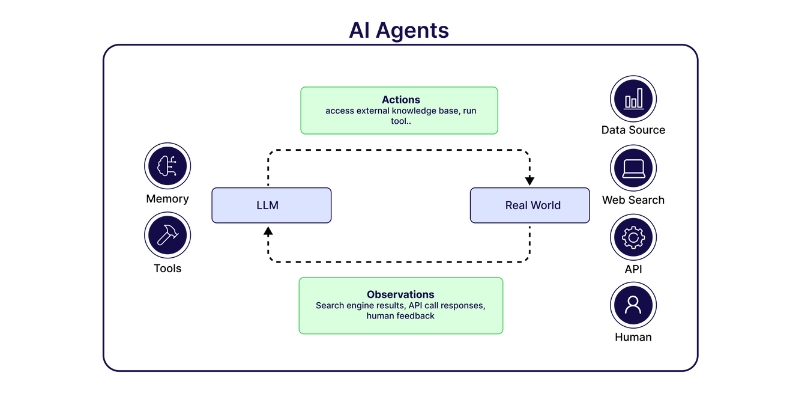
How AI agent tools work
Step 1: Task reception and analysis
The AI agent first receives a task or request. It examines the task’s requirements - what data is available, what outcome is expected, and any constraints that must be considered. This analysis sets the stage for tool usage.
Step 2: Tool capability assessment
The agent reviews its available tools, each described with metadata such as its name, purpose, required inputs, and expected outputs. This helps the agent understand which tools are relevant for the task at hand.
Step 3: Matching task to tools
The agent matches the task’s needs with the capabilities of each tool. It checks whether the tools can accept the given data, produce the required output, and operate under the defined conditions.
Step 4: Tool selection
The most suitable tool is selected based on relevance, efficiency, and past success. If multiple AI agent tools fit, the agent evaluates which is most likely to achieve the goal effectively.
Step 5: Argument preparation
Once a tool is chosen, the agent formulates the necessary inputs or parameters, ensuring they meet the tool’s requirements. This step may include validating or adjusting the input format.
Step 6: Tool execution
The agent invokes the selected tool - this is known as a tool call. The external system, API, or function is executed on the agent’s behalf, performing the required action.
Step 7: Result processing
The tool returns its result, which the agent then processes or formats to fit the task’s context.
Step 8: Task continuation
Finally, the agent uses the tool’s output to either complete the task, trigger another tool, or return a response to the user. In some cases, the result may also be shared with other agents in a multi-agent system for further actions.
Choosing the right AI agent platform can feel like navigating a rapidly evolving landscape. The top AI agent tools in 2025 below are shaping the future of automation, data analysis, and decision making.
LangGraph
As part of the LangChain ecosystem, LangGraph has quickly become one of the most recognized frameworks for building advanced software agents. Its graph-based architecture allows developers to create stateful, cyclical workflows using nodes (models, tools, or virtual assistants ) and edges (the logical connections between them). This makes it ideal for orchestrating robotic process automation or developing multi-step reasoning agents. With a robust library of orchestration and memory-handling tools, plus a visual LangGraph Platform, it strikes a balance between deep customization and accessible design.
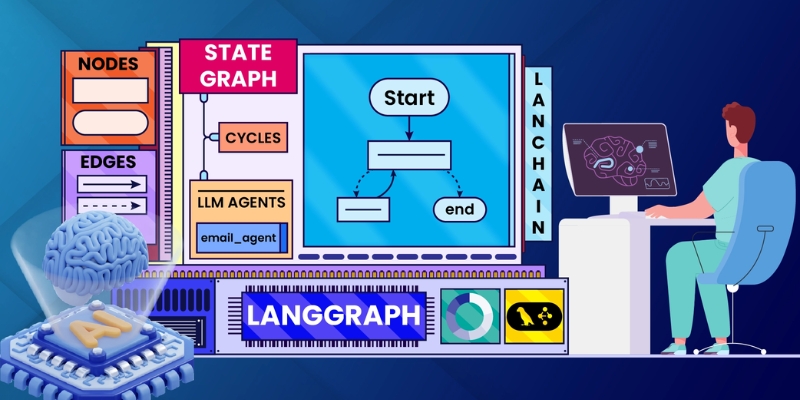
LangGraph
AutoGen
Developed by Microsoft, AutoGen is one of the most common AI agent tools built for creating collaborative, multi-agent systems that can operate autonomously or alongside humans. With an event-driven architecture, it supports long-running intelligent systems capable of complex interactions. Its suite includes AutoGen Core for production-ready systems, AgentChat for prototyping, and AutoGen Studio for visual development. By connecting multiple software agents, businesses can accelerate processes such as customer support, internal workflow optimization, and cross-agent decision making.
Also read: Agentic AI Architecture: Everything You Need To Know
Semantic Kernel
Another Microsoft innovation, Semantic Kernel acts as middleware, bridging machine learning models (like OpenAI or Hugging Face) with conventional coding languages such as Python, Java, or C#. This SDK empowers developers to enrich existing infrastructures with natural language processing and AI-driven orchestration. It’s particularly well-suited for enterprise-scale data analysis, AI-powered planning, and extending the capabilities of legacy systems.
IBM WatsonX.AI
IBM’s WatsonX.AI offers a powerful suite of APIs, SDKs, and workflows designed for enterprise-grade automation. It supports a wide array of foundation models, enabling domain-specific customization for tasks like predictive analytics and scalable data analysis. With built-in tools for governance, deployment, and model selection, WatsonX.AI is particularly well-suited for industries requiring strict compliance and security.
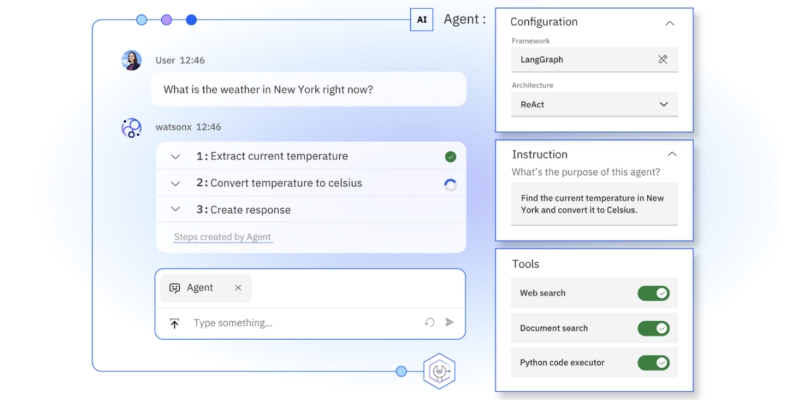
IBM WatsonX.AI
Langflow
Langflow has become a major player in the low-code AI agent tools market, offering a visual editor to create multi-agent systems and RAG-based tools. Its interface allows users to drag, drop, and connect components such as prompts, LLMs, and databases - perfect for organizations seeking robotic process automation without sacrificing the ability to customize via Python scripts. Its dedicated Agent component also enables decision making flows powered by AI agents.
Flowise
Flowise offers a highly intuitive drag-and-drop platform for creating AI agents without writing code. Despite its no-code nature, it supports over 100 LLMs, vector databases, and embedded tools for data analysis. It also includes execution tracing and human-in-the-loop feedback, making it ideal for controlled automation in dynamic environments.
Zapier
Zapier, a household name in workflow automation, now enables users to build virtual assistants using plain language instructions. With over 7,000 integrations and a rich library of templates, Zapier simplifies predictive analytics-driven workflows and allows users to refine agents with natural feedback, making it one of the fastest ways to turn ideas into functioning systems.
LangSmith
Part of the LangChain family, LangSmith focuses on observability - tracing, debugging, and monitoring software agents. Its dashboards, human feedback loops, and LLM-as-judge tools help teams ensure reliable agent behavior. It’s particularly valuable for organizations deploying machine learning systems at scale, where visibility and control are paramount.
LangFuse
LangFuse is an open-source platform for debugging, tracing, and managing LLM-based agents. With strong prompt management capabilities, version control, and integration options, it offers teams detailed oversight of their AI systems in production - essential for fine-tuning intelligent systems that power decision making and data analysis at scale.
AI agent tools are already transforming how businesses operate by enabling agents to retrieve information, execute tasks, and integrate seamlessly with various systems. Here are some of the most impactful real-world use cases:
Information retrieval
AI agents can search across knowledge bases, document stores, or the web to gather relevant information instantly. This allows businesses to access up-to-date insights without manual effort, improving decision-making speed and accuracy.
Computation & data processing
With AI agent tools like calculators, data processors, and code interpreters, agents can perform complex calculations, analyze datasets, or execute snippets of custom code. This reduces human workload and accelerates data-driven tasks.
API integration
Agents can connect to external APIs, such as weather services, stock market data, or travel booking platforms. This makes them more interactive and capable of delivering real-time, actionable information.
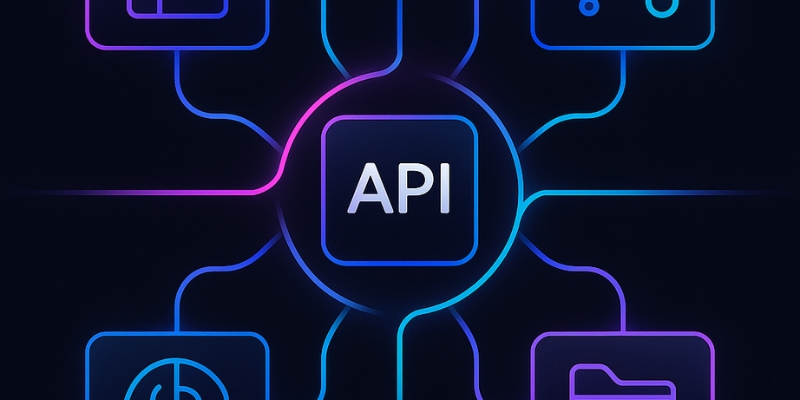
API integration
Database access & management
AI agent tools designed for querying, formatting, and organizing databases enable agents to keep large datasets structured and up to date. This is particularly useful for businesses managing customer data or operational records.
Content generation
From creating images to drafting text or formatting documents, these tools help agents produce tailored content on demand, speeding up workflows and enhancing creativity.
Integrated digital assistants
A single AI agent equipped with multiple tools can manage emails, update calendars, fetch files from cloud storage, and highlight important team communications (e.g., Gmail, Google Drive, Slack). This transforms it into a proactive digital secretary for both personal and business tasks.
Choosing the right AI agent framework is essential because it determines how effectively your AI agent tools can operate. While tools enable agents to perform actions and connect with external systems, the framework provides the structure that brings everything together. A well-matched framework ensures your tools work seamlessly, scale efficiently, and deliver the results your business needs. Follow this guide to choose the right AI agent framework for your business.
Start with your use case complexity
Begin by assessing how complex your workflows and requirements are. If your goal is to create a straightforward virtual assistant that automates basic tasks, you may benefit from entry-level frameworks such as Agno or CrewAI. These provide simple syntax, ready-to-use templates, and minimal configuration, making them ideal for quick deployment.
On the other hand, if your organization needs to build more advanced systems - think robotic process automation or multi-agent networks that handle loops, branching logic, and escalation workflows - frameworks like LangGraph and AutoGen are more suitable. They are built to support stateful, cyclical workflows that can retry failed steps or coordinate multiple agents seamlessly.
Consider integration needs
Integration is critical because AI agents rarely operate in isolation. A well-chosen framework should easily connect with your existing tech stack, APIs, and enterprise systems to enable real-time data analysis and predictive analytics.
If your company already relies heavily on Microsoft Azure or similar environments, Semantic Kernel offers a deep level of compatibility with major APIs and cloud-native tools. For organizations needing broader connectivity - where agents must pull from a wide range of proprietary or third-party sources - CrewAI and LlamaIndex are strong choices, allowing your agents to interact dynamically with both internal and external data sources.
Evaluate ease of use versus customization
Different teams have different skill levels, and your framework should match the expertise of your developers or business users. No-code and low-code platforms like Flowise and Zapier make it possible for non-technical users to build and deploy software agents using drag-and-drop interfaces and natural language prompts.
In contrast, if your team consists of experienced developers who require granular control over machine learning models, orchestration logic, and tool integrations, frameworks like Atomic Agents or LangGraph offer the raw flexibility needed to create highly tailored AI systems.
Prioritize security and compliance
Data privacy and regulatory compliance cannot be an afterthought, especially in industries like healthcare, banking, or government services. Some frameworks, such as OpenAI’s Agent SDK, are designed for on-premise deployment, ensuring sensitive data never leaves your local environment. Others, like Semantic Kernel, offer enterprise-grade encryption, access control, and compliance features for cloud-based projects, supporting standards like GDPR and HIPAA. Before selecting a framework, review the vendor’s security and data handling policies to avoid risks like data breaches, unauthorized access, or biased outputs.
Assess scalability and performance
Finally, think long term: can the framework handle your future demands? For businesses expecting heavy user traffic, large datasets, or expansive automation pipelines, scalability is essential. LangGraph excels at managing thousands of simultaneous workflows, making it a strong option for fraud detection, customer service orchestration, or other data-heavy use cases. If you’re building distributed, enterprise-grade systems such as supply chain automation or global decision making networks, Microsoft’s AutoGen provides robust infrastructure for scaling across complex environments.
AI agent tools unlock the full potential of AI agents, turning them into proactive, task-oriented systems capable of interacting with data, applications, and external services. By leveraging these tools, businesses can automate complex workflows, improve decision-making, and enhance operational efficiency.
To harness these capabilities without the hassle of building everything from scratch, consider partnering with Sky Solution. Our agentic AI solutions help your business streamline processes, optimize performance, and deliver smarter results faster. Contact us now for a free consultation today.




.jpg&w=3840&q=75)
.jpg&w=3840&q=75)