Lucia Lee
Last update: 21/11/2025
AI has become indispensable for businesses looking to stay ahead of their industry, but not all AI tools are effective in today’s rapidly changing market. As customer expectations evolve by the minute, businesses can no longer rely on static, rule-based systems. They need AI that gets smarter with every interaction. That’s exactly where learning agents step in. These adaptive AI systems don’t follow rigid scripts - they observe, adjust, and improve over time. Keep reading to explore the essentials of learning agents in AI: what they are, how they work, the components behind their adaptability, and the real-world applications driving business transformation today.
Learning agents are a special class of systems in artificial intelligence designed not just to act, but to evolve. Like any intelligent agent, they perceive their environment and take actions toward a goal - but what sets them apart is their ability to improve those actions over time. Instead of relying on fixed, pre-programmed rules, a learning agent functions as an autonomous system that gathers experience, analyzes outcomes, and adjusts its decision-making based on what it learns.
This adaptability makes learning agents fundamentally different from traditional AI models. Where classical systems follow rigid instructions, learning agents modify their strategies as they encounter new scenarios. They observe patterns, evaluate feedback, and refine their next move, resulting in continuously adaptive behavior that mirrors how humans learn through trial and error.
Also read: Types of Agentic AI Agents Explained with Examples
A learning agent isn’t a single mechanism - it’s a coordinated system built from several interconnected parts that enable continuous improvement. This learning architecture for intelligent agents ensures the agent can sense its environment, act, learn from outcomes, and refine its behavior over time. Below are the core components that make this learning loop possible.
Learning element
The learning element in AI agents is responsible for analyzing experience and improving the agent’s performance. It processes feedback, interactions, and training data, using an algorithm such as supervised learning, unsupervised learning, or reinforcement learning. This is where true knowledge acquisition in AI happens - it updates internal models, adjusts strategies, and ensures the agent becomes smarter with every iteration.
Performance element
While the learning element focuses on improvement, the performance element handles execution. It interacts directly with the environment, selecting actions based on the current policy or knowledge base.
Critic
The performance element and critic work together: the performance element acts, and the critic evaluates to guide future learning. The critic monitors the agent’s actions and measures them against goals, outcomes, or a reward structure. By identifying what worked and what didn’t, it provides essential signals that guide the learning element. This feedback loop ensures the agent doesn’t just act - it improves.
Sensors and actuators
Sensors (or perceptors) collect data from the environment, enabling the agent to understand its surroundings. Actuators execute decisions, completing the cycle from perception to action. Together, they allow the agent to operate as an adaptive, interactive system.
Problem generator
The agent’s problem generator pushes the agent beyond routine behavior by proposing new actions or scenarios to explore. It prevents stagnation by encouraging experimentation, ensuring the agent encounters diverse experiences that lead to deeper learning. This exploratory function is key to avoiding locally optimal but globally suboptimal behavior.
Learning agents operate through a continuous loop of observation, learning, and action - a process that enables autonomous adaptation as conditions change. This agent improvement cycle is what turns a static system into one capable of evolving over time. Here’s a clear breakdown of how agents learn from environment signals and refine their behavior with each iteration.
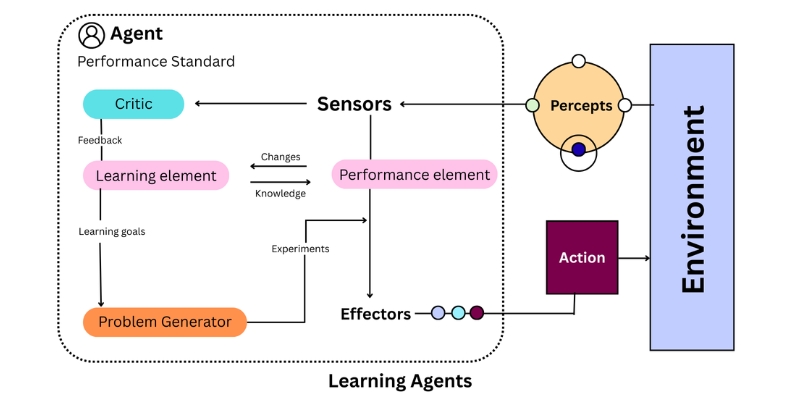
How learning agents in AI work
Perceiving the environment
Everything begins with environment interaction. The agent observes its surroundings through sensors, collecting real-time data about the current state and the outcomes of its previous actions. This perception stage is essential for knowledge acquisition, giving the agent the raw information it needs to evaluate what is happening and why.
Taking action through decision-making
Next, the performance element steps in, applying the agent’s current strategy to select an action. This is the core of the agent’s decision making process - choosing what to do based on what it currently “knows.” At this point, the agent may not be perfect, but every action contributes to its eventual learning.
Evaluating outcomes with the critic
Once the action is taken, the critic evaluates its effectiveness. This is where reinforcement learning fundamentals come into play: the agent receives signals indicating success, failure, or somewhere in between. This feedback becomes the foundation for refinement, guiding the agent toward behaviors that achieve better outcomes.
Learning and updating internal models
Using feedback from the critic, the learning element updates the agent’s internal knowledge. This is where internal model building in learning agents happens - adjusting strategies, updating predictions, and improving rules based on past experiences. Through repeated updates, the agent begins to exhibit self-optimizing agent behavior, steadily moving toward more effective actions.
Exploring with the problem generator
To avoid stagnation, the agent’s problem generator proposes new scenarios or actions to try. This encourages exploration, ensuring the agent doesn’t simply repeat what already works but continues searching for better strategies or outcomes.
Learning agents rely on several machine learning approaches to adapt, improve, and make informed decisions. Each learning type equips the agent with different capabilities, depending on the complexity of the environment and the kind of feedback available.
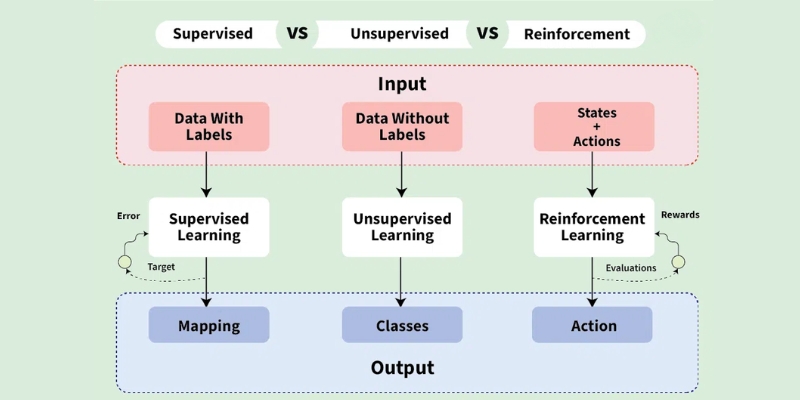
Types of learning used by learning agents
Supervised learning
In supervised learning, the agent trains on labeled datasets where every input is paired with a correct output. This structure allows the agent to learn precise mappings - ideal for applications like image classification, fraud detection, or language translation. The key challenge is the need for large amounts of high-quality labeled data, but when available, supervised learning enables highly accurate predictions and strong generalization.
Unsupervised learning
Unsupervised learning helps the agent uncover patterns or relationships hidden within data that lacks labels. By clustering, detecting anomalies, or identifying latent structures, the agent can extract insights that wouldn't appear through manual observation. This form of learning supports recommendation systems, anomaly detection, and data compression - making it powerful for environments where labeling is impractical or too costly.
Reinforcement learning
Unlike the previous two approaches, reinforcement learning teaches the agent through trial and error. The agent interacts with its environment, receives rewards or penalties, and gradually develops policies that maximize long-term returns. This makes reinforcement learning especially suited for robotics, autonomous navigation, game-playing systems, and dynamic optimization tasks.
A common approach within reinforcement learning is Q-learning, where agents learn the value of each state-action pair and store them in a Q-table. While effective for smaller tasks, Q-tables break down in large or high-dimensional environments. To overcome this, neural networks are used to approximate Q-values, enabling learning from raw sensory inputs. Deep Q-networks (DQNs) extend this further, fusing deep learning with reinforcement learning to allow agents to map complex observations directly to actions.
Learning agents are reshaping how modern systems operate by enabling continuous adaptation, smarter machine learning-driven decisions, and dynamic responses to real-world uncertainty. Their ability to learn from data, interactions, and outcomes makes them a powerful foundation for innovation across industries. Here’s how they’re being applied today.
Healthcare
Learning agents are redefining healthcare by turning massive medical datasets into actionable insights that support more accurate diagnoses and personalized treatment planning. These systems learn from patterns in scans, lab results, and patient histories - spotting subtle indicators that might escape even experienced clinicians.
As learning agents continuously refine their models through new data and real-world feedback, they help streamline clinical workflows, reduce diagnostic errors, and elevate overall patient outcomes.
Also read: Personalized Healthcare: Benefits, Solutions, and Trends
Customer service
In customer service, learning agents enable support systems that become smarter and more context-aware with every interaction. By learning from past conversations, they deliver more accurate responses, understand intent more clearly, and personalize support in ways traditional scripted systems can’t match. Modern conversational AI platforms already use these models to analyze tone, context, and historical preferences, allowing them to adapt in real time during customer interactions.

Customer service
Autonomous systems
Autonomous systems rely heavily on learning agents to navigate dynamic environments, make safe decisions, and continually improve their behavior. These agents absorb real-time sensory data - visual cues, road conditions, object movements - and adjust their decision-making strategies through experience.
Beyond transportation, autonomous agricultural machines use similar learning-driven adaptation to handle varying soil conditions, weather patterns, and field layouts. The ability to learn continuously enables autonomous systems to operate with greater reliability, efficiency, and safety across unpredictable real-world scenarios.
Robotics & industrial automation
In robotics and industrial automation, learning agents allow machines to operate with far more flexibility and precision than traditional rule-based systems. Instead of relying on fixed programming, robots equipped with reinforcement learning explore actions, evaluate outcomes, and refine their behavior to maximize performance. This results in smoother motion control, more accurate manipulation, and better collaboration with human workers.
On manufacturing floors, robotic arms use learning-driven neural networks to enhance precision in tasks like welding and assembly, improving with each operation. By processing complex visual and spatial data, learning agents enable robots to make decisions that closely resemble human judgment - transforming efficiency and safety in industrial environments.
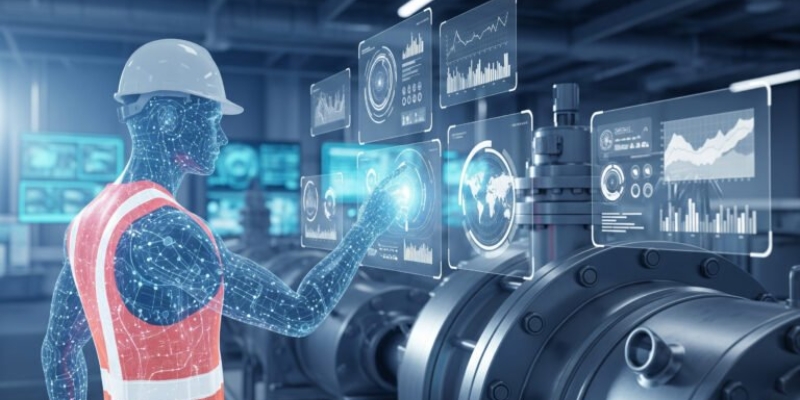
Robotics & industrial automation
Simulation & agent-based modeling
Learning agents play a powerful role in simulation environments, where they test strategies, optimize decisions, and model complex real-world systems without the risks associated with physical trials. These agents learn by experimenting within a simulated world - adjusting their actions, refining their predictions, and uncovering optimal pathways over time.
For example, urban planners leverage learning agents to simulate traffic flows and evaluate interventions before implementation, while epidemiologists use agent-based models to understand how diseases spread under varying behavioral patterns. Because learning agents improve continuously during the simulation, they provide more realistic insights that guide better policymaking and operational planning.
Intelligent devices & smart systems
Smart systems - from home appliances to autonomous cleaning devices - depend on learning agents to adapt to user behavior and optimize performance. Over time, these agents create highly personalized user experiences, turning ordinary devices into intuitive, adaptive systems that simplify daily life through automation and contextual intelligence.
Digital platforms, virtual assistants & recommender systems
Digital platforms rely on learning agents to enhance user experiences through personalization, moderation, and predictive content delivery. Streaming and e-commerce platforms, for instance, use similar learning models to analyze viewing or shopping behavior, delivering personalized recommendations personalized recommendations that evolve as user preferences change. These adaptive systems form the backbone of modern digital ecosystems by making interactions more natural, relevant, and user-centric.
Finance & fraud detection
In finance, learning agents empower systems that analyze high-volume, rapidly changing data to make split-second decisions with increasing accuracy. Trading platforms use these agents to detect patterns, predict market movements, and refine strategies as new data arrives.
Fraud detection systems learn to identify anomalies that signal suspicious activity and become more accurate with each confirmed detection. By continuously learning from both normal and abnormal behavior, these models enhance financial security and enable institutions to respond to threats faster and more effectively than rule-based methods.
As businesses look for smarter, more flexible AI solutions, learning agents have become a valuable asset, bringing about various benefits.
Continuous improvement
One of the defining strengths of learning agents is their capacity for continuous self-improvement. Unlike static rule-based systems that perform the same way from day one, learning agents keep evolving as they encounter new data, feedback, and real-world scenarios. Every interaction becomes part of their growing knowledge base, allowing them to refine their internal models and elevate their performance over time. This makes them especially valuable in environments where ongoing optimization is essential.
Also read: Simple Reflex Agents: What They Are, How They Work, & More
Better decision-making over time
Learning agents become more reliable the longer they operate because they learn from both their successes and their mistakes. By analyzing past outcomes, they gradually improve the accuracy and relevance of their decisions. This feedback-driven refinement helps them make choices that are not only more efficient but also more contextually aligned with long-term goals. As a result, organizations benefit from decision-making that grows smarter and more precise with every iteration.
Adaptability to dynamic environments
Traditional AI systems often struggle when conditions shift unpredictably, but learning agents thrive in these environments. Their adaptive nature allows them to respond to changes - whether in user behavior, physical surroundings, or operational constraints - without requiring manual reprogramming. This flexibility makes learning agents ideal for applications like autonomous vehicles, logistics automation, ecommerce personalization, and any system where real-time adjustment is crucial for success.
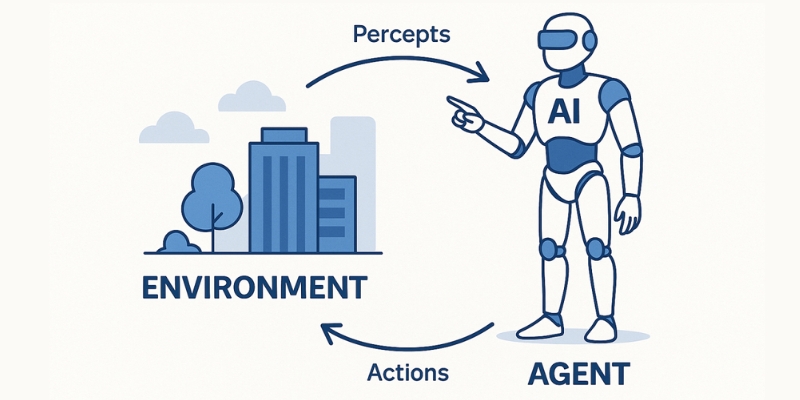
Adaptability to dynamic environments
Reduced need for human intervention
Once trained effectively, learning agents can operate with minimal human oversight. Their ability to self-correct, update strategies, and make autonomous decisions reduces the demand for constant monitoring or manual tuning. This is particularly advantageous in large-scale or high-complexity systems, where it would be impractical for human operators to manage every edge case. By minimizing intervention while maintaining high performance, learning agents deliver long-term operational efficiency and scalability.
While learning agents offer competitive advantages for businesses, building and scaling them in real-world environments comes with several obstacles.
Balancing exploration and exploitation
One of the biggest hurdles in developing learning agents is managing the constant tension between trying new actions and relying on proven strategies. This exploration vs. exploitation trade-off is easy to describe but difficult to optimize in practice. Algorithms like epsilon-greedy help, but the ideal balance is always context-dependent. Too much exploration wastes time and resources; too much exploitation traps the agent in suboptimal behavior. Designing this equilibrium is one of the core challenges in building dependable learning systems.
High computational demands
Learning agents - especially those powered by deep reinforcement learning - often require significant processing power, memory, and time. Techniques like Deep Q-Learning may deliver impressive results, but they also demand heavy computational resources during training. In environments with large, complex state-action spaces, building and refining these agents becomes even more intensive. For many organizations, this makes real-time learning or on-device deployment difficult without substantial infrastructure investment.
Scalability and limited transfer learning
While learning agents excel in controlled or narrowly defined environments, scaling them to large, dynamic, or multi-dimensional domains remains an ongoing challenge. Many agents struggle to generalize - knowledge gained in one environment doesn’t always transfer well to another. Transfer learning is still developing in this space, and its limitations make it hard to deploy the same agent across varied tasks without extensive retraining. This lack of flexibility can slow down real-world adoption.
Data quality and availability
A learning agent is only as good as the data it learns from. Poor-quality, biased, or insufficient training data leads to incomplete learning and unreliable decisions. In high-stakes fields like healthcare, finance, or autonomous driving, this isn’t just inefficient - it can be dangerous. Compounding this issue is the cost of collecting high-quality real-world data, which can be both expensive and time-consuming. Ensuring that agents learn from diverse, accurate, and representative datasets is one of the most persistent obstacles in modern AI development.

Data quality and availability
Safety and reliability in decision-making
In environments where mistakes carry real consequences - such as clinical diagnosis or autonomous navigation - learning agents must operate within strict safety boundaries. But because these systems learn by trial and error, ensuring safe behavior throughout the learning process isn’t straightforward. Developers often need to build safety constraints, guardrails, or fallback systems to prevent harmful decisions. Balancing autonomy with reliability remains a critical challenge in deploying learning agents responsibly.
Learning agents in AI are revolutionizing how businesses tackle complexity, adapt to change, and make smarter decisions. From autonomous systems to personalized services, these self-improving agents bring continuous learning, enhanced efficiency, and scalable intelligence to the forefront of innovation. While challenges like data quality and computational demands exist, the benefits of adaptability and self-optimizing agent behavior make them a game-changer for modern enterprises.
Ready to harness the power of learning agents for your business? Sky Solution’s AI agent solutions can help you build and implement intelligent, adaptive systems that evolve with your needs - driving smarter decisions and stronger results. Contact us now for a free consultation.




.jpg&w=3840&q=75)

.jpg&w=3840&q=75)


